The past few weeks have been pretty busy so I put blog-reading on the back burner. But after just a week I started missing my normal haunts and feeling withdrawal symptoms. I initiated a sort of "rotation system" to try to read a couple a day, just to keep up with things.
Then yesterday I went on a bender. I sat down with my bookmarks and blissed my way through a few hours of unabated blog browsing! Ahhh, I feel so much better now!
Here are some of the highlights from my blitz:
A 23-year old Venetian has broken through the pink curtain to become her city's first female gondolier.
Sara Rosso, best known as Ms. Adventures in Italy, dished about the newest caffeine trend from the makers of Pocket Coffee. (For those who may not know, Pocket Coffee is an espresso-filled chocolate candy that has garnered a cult following.) Because of the melty nature of chocolate, they stop distrubuting their product in the summer. Enter Pocket Espresso, the new hot-weather alternative, a chocolate-espresso sippy cup. I ask you, can Pocket Caffe` Corretto be far behind?
Lola shares a fabulous-looking no-bake raspberry tart recipe at her drool-worthy cooking blog, Aglio, Olio, e Peperoncino.
The cool Rome blog, Eternally Cool, takes us on a tour of some astounding sand sculptures, in their article, Dante's Got Sand Between His Sheets.
Kathy at Dream of Italy tells us how to minimize the Monday Dilemma when traveling in Italy, and make the most of the day when many restaurants and museums are closed.
Read a poignant discussion of why la mamma is more than a mother in Italian life by Barbara at Savour the Sannio.
And finally, find out how a GPS error led a Swedish couple 650 km astray!
Now back to work.
Friday, July 31, 2009


Friday, July 24, 2009
Be Neighborly - Buy Locally
One of the (many) things we love about life in Italy is the sense of community. People gather in the piazzas, chat on park benches, and meet regularly for un caffe` or aperitivo in their favorite haunt. The mom-and-pop shop is still alive and well and steadfastly supported by neighborhood residents.
We knew that when we bought veggies at the mercato dell'erbe the person we were buying from was also the grower. My butchers (yes plural, one for meat and lamb, another who specialized in poultry and pork) were small operators who knew personally where the products came from, nothing traveling far to reach their shops. The folks at the salumeria carefully crafted the prosciutto and salami they were selling, and carried a wide range of formaggi from local farms. They were finicky when it came to which out-of-region cheese makers they would sell, opting only for the parmiggiano or mozzerella that fit their standards.
The supermercato in the centro that I frequented was locally-owned but aligned with a consortium for buying power, much like the Ace or True Value hardware stores around here. Ascoli has no chain restaurants in the centro (and even very few outside it) and while there are chain fashion stores scattered around town, there are still just as many (or more) sole proprietor businesses there, too.
We developed connections with the owners, so when we announced our departure they expressed how sad they were to see us go, and some even unabashedly cried.
Such is the way of life in many parts of Italy and we love it. They recognize that having shops in the neighborhood that you can walk to is an asset, and that having a chiacchierata (chat) with the owner or your neighbors while you're there is a nice thing, too.
We're fortunate that here in Cleveland Heights this kind of community spirit is still fairly well alive. A locally-owned (and very nice) grocery store is just two blocks away. There are two streets within a short walkable distance that boast many different ethnic eateries and coffee bars, and they organize street fairs and open-air movie nights.
Buying local feels good, and studies show that it keeps more money in the local economy than the corporate giants. Of course, in today's world you can't find everything you need at mom-and-pop shops. I realize that. But the rise of "town center" malls is disturbing to me. Why build a fake "town" when you can support the real one in which you live.
3/ What 3 independently-owned businesses would you miss if they disappeared? Stop in. Say hello. Pick up something that brings a smile. Your purchases are what keeps those businesses around.
50/ If half the employed population spend $50 each month in locally owned independent businesses, it would generate more than $42.6 billion in revenue. Imagine the impact if 3/4 of the employed population did that. (According to US Labor Department statistics.)
For every $100 spent in local independently owned stores, $68 returns to the community through taxes, payroll, and other expenditures. If you spend that much in a national chain, only $43 stays here. Spend it online and nothing comes home.
We are already committed to buying locally whenever possible. But I think this challenge of 3/50 is very doable for those who may not have thought about it in quantative (or quality of life) terms before. Spending $50 of your monthly budget in a local shop, restaurant, or grocery store is easy to do, and may just garner you some friends!
So will you join me? Visit those 3 shops that you would hate to see go away forever. Spend your date night in a local eatery. Make your neighborhood Ace or True Value your first stop for hardware needs before going to the big box store. Grab your pizza at the family-run pizzeria, or your burger from a pub instead of a national chain. Visit the area's farmers markets.
It not only makes you feel good about helping your local economy and supporting your town's business owners, it gives you real connections with people in your area. And being neighborly and helping to foster a sense of community is something we could all enjoy, don't you think?
We knew that when we bought veggies at the mercato dell'erbe the person we were buying from was also the grower. My butchers (yes plural, one for meat and lamb, another who specialized in poultry and pork) were small operators who knew personally where the products came from, nothing traveling far to reach their shops. The folks at the salumeria carefully crafted the prosciutto and salami they were selling, and carried a wide range of formaggi from local farms. They were finicky when it came to which out-of-region cheese makers they would sell, opting only for the parmiggiano or mozzerella that fit their standards.
The supermercato in the centro that I frequented was locally-owned but aligned with a consortium for buying power, much like the Ace or True Value hardware stores around here. Ascoli has no chain restaurants in the centro (and even very few outside it) and while there are chain fashion stores scattered around town, there are still just as many (or more) sole proprietor businesses there, too.
We developed connections with the owners, so when we announced our departure they expressed how sad they were to see us go, and some even unabashedly cried.
Such is the way of life in many parts of Italy and we love it. They recognize that having shops in the neighborhood that you can walk to is an asset, and that having a chiacchierata (chat) with the owner or your neighbors while you're there is a nice thing, too.
We're fortunate that here in Cleveland Heights this kind of community spirit is still fairly well alive. A locally-owned (and very nice) grocery store is just two blocks away. There are two streets within a short walkable distance that boast many different ethnic eateries and coffee bars, and they organize street fairs and open-air movie nights.
Buying local feels good, and studies show that it keeps more money in the local economy than the corporate giants. Of course, in today's world you can't find everything you need at mom-and-pop shops. I realize that. But the rise of "town center" malls is disturbing to me. Why build a fake "town" when you can support the real one in which you live.

3/ What 3 independently-owned businesses would you miss if they disappeared? Stop in. Say hello. Pick up something that brings a smile. Your purchases are what keeps those businesses around.
50/ If half the employed population spend $50 each month in locally owned independent businesses, it would generate more than $42.6 billion in revenue. Imagine the impact if 3/4 of the employed population did that. (According to US Labor Department statistics.)
For every $100 spent in local independently owned stores, $68 returns to the community through taxes, payroll, and other expenditures. If you spend that much in a national chain, only $43 stays here. Spend it online and nothing comes home.
We are already committed to buying locally whenever possible. But I think this challenge of 3/50 is very doable for those who may not have thought about it in quantative (or quality of life) terms before. Spending $50 of your monthly budget in a local shop, restaurant, or grocery store is easy to do, and may just garner you some friends!
So will you join me? Visit those 3 shops that you would hate to see go away forever. Spend your date night in a local eatery. Make your neighborhood Ace or True Value your first stop for hardware needs before going to the big box store. Grab your pizza at the family-run pizzeria, or your burger from a pub instead of a national chain. Visit the area's farmers markets.
It not only makes you feel good about helping your local economy and supporting your town's business owners, it gives you real connections with people in your area. And being neighborly and helping to foster a sense of community is something we could all enjoy, don't you think?
Friday, July 17, 2009
A Small Place in Italy
Eric Newby was a wonderful travel writer who chronicled his experiences as an escaped prisoner of war being protected and housed by Italians in his famous book, Love and War in the Apennines. His sequel of sorts was A Small Place in Italy, where Newby tells of returning to Italy with his wife to buy a casa. With characteristic dry wit and descriptive character sketches, he recounts the restoration of the ruined farmhouse and the bureaucracy and friends they meet with along the way.

I pulled it out of a box in the attic because it's been several years since I first read his narrative. I enjoyed it a lot back then, more so than other (uh...shall we say more self-possessed? Pompous?) memoirs about buying and restoring property in Italy. I'm also paying more much more attention to the details than I did on my initial reading.
Remember in this post when I told you we made an impulse buy of a special keepsake? Well, we bought a house! Okay, actually it is a very small apartment, but it is a habitable piece of property nonetheless. We looked at it during our sojourn in Basilicata and debated over it for a few weeks. We made the decision to buy just 16 hours before we left the country. It may seem crazy to you, but it made perfect sense to us, and it definitely made it easier to board that plane, let me tell you.
Oh yeah, did I mention that we made the purchase agreement over the phone? We had already met with the owner, who resides in Rome, and she took a liking to us. We stayed and chatted with her for a few hours, talking about all manner of things, and by the time we departed she had invited us to her vacation home in northern Le Marche.
For some reason - now we are not sure why - we debated over it for another solid week (after meeting the owner) while we packed and stored our stuff. Finally, the day before we were due to leave we looked at each other and said, "Good grief, what is there to debate about? It's cheap, it's actually habitable, and it is in a location we love." And so that decided it.
That, along with the fantastic view from the windows. And, the key selling point for Bryan, it comes with two cantine, hewn right into the rock hillside, where generations upon generations have stored their vino and prosciutto and other goods. It is also in easy reach of my ancestral villages.
We are waiting on the paperwork, but we will soon have our own small place in Italy and we couldn't be happier about it. While our lives are currently in flux, the one place on earth we know we will return to for the rest of our lives is Basilicata, (the motherland) and we have a home to go back to.
Friday, July 10, 2009
Reunion Week Continues
We are still on the road; I guess we figured that since we’ve been living the life of vagabondi anyway, we may as well make it mobile for a while. There are lots of people we haven’t seen in a long time. Besides, since summer had not yet arrived in Cleveland when we left twelve days ago, we’ve had to go looking for sun and warmth. Strange how I don’t remember those weather quirks from my childhood there.
As I mentioned, our first stop was to hang out with cousin Celia. She lives in the woods along the South Carolina-North Carolina border, just outside two cute towns with a casual artsy feel to them. We spent time perusing cookbooks (well…Celia and I did, while Bryan and Rhonda perused financial websites and the latest issue of Garden and Gun magazine…don’t ask!) We cooked and ate and talked food and watch Big Night.
Then we all packed it up and took the culinary show on the road to Celia’s dad’s in Atlanta. George is my father’s first cousin. While the family certainly talked fondly about the southern Italian relations who lived in the South, I don’t remember meeting them, though I am sure I did at some point in my childhood. They were like the New York branch of the family that I grew up hearing about but didn’t really know, yet my grandfather would say, “You know Angela…she’s your cousin in New York,” and such-like things that indicated that familial connections, however tenuous, were still strands in the tapestry.
 That makes George my second cousin, and he had some great stories about my grandparents that I had never heard before. I am pleased that I will have something to razz my grandpa about when I get back to Ohio, as he is a curmudgeonly kind of guy who loves nothing more than barking harmlessly and poking at people to get a rise out of them. Shoe’s on the other foot finally!
I met Celia’s brother for the first time, along with Leandra, another cousin a couple times removed, who I loved immediately. Her mother Rose came to visit us in Italy and we had a wonderful time. I heard Rose in Leandra’s voice. There we were, a group of cousins, who crowded the kitchen, cranked out cavatelli, simmered up sauce, and ate and interacted boisterously. You know, like any other Italian family.

 We headed back to northern South Carolina to spend a few days with Bryan’s parents. It’s nice having family in southern climes! They live at the foothills of the Blue Ridge mountains near a couple of pretty lakes, so we enjoyed a relaxed time picnicking on a shoreline, driving to a rustic mountain town, and sitting on their blessedly screened-in porch. I could see the mosquitoes lining up outside the finely-woven barrier, trying desperately to get to me while I remained uneaten, saying ‘ha-ha suckers!’ Mosquitoes love me and will travel great distances to swarm me.
Bryan’s mom, mindful that we didn’t have a true Thanksgiving in three years, cooked up a turkey dinner with all the fixings. (Yes, it tasted unbelievably good!) His parents were also very concerned for Bryan’s well-known caffe cravings, and purchased espresso for the moka pot he brought along, and had pre-screened the local coffee joints for him, too.
 And that brings us to Washington for a couple days where we are reconnecting with some friends and – you knew this was coming – more family. We are meeting my aunt and cousins for dinner tonight. As I type this I am realizing that all our family activities always seem to revolve around food. (Is your family like that, too?)
We’ll be heading back to Ohio tomorrow. We need to be there for…ta dum…a family reunion! I know, it seems like there can’t be anyone else to reunite with, but there you have it. Two minutes after we arrived in America my grandfather informed us of the date of this reunion, stating how just once before he dies he would like someone, any one of his grandchildren, to go with him to the annual gathering of his branch of the family, and seeing as he is 96 he really thought it should be this year. Well, can’t very well ignore that kind of guilt, can we? Besides, I’m sure there will be good food involved.
As I mentioned, our first stop was to hang out with cousin Celia. She lives in the woods along the South Carolina-North Carolina border, just outside two cute towns with a casual artsy feel to them. We spent time perusing cookbooks (well…Celia and I did, while Bryan and Rhonda perused financial websites and the latest issue of Garden and Gun magazine…don’t ask!) We cooked and ate and talked food and watch Big Night.
Then we all packed it up and took the culinary show on the road to Celia’s dad’s in Atlanta. George is my father’s first cousin. While the family certainly talked fondly about the southern Italian relations who lived in the South, I don’t remember meeting them, though I am sure I did at some point in my childhood. They were like the New York branch of the family that I grew up hearing about but didn’t really know, yet my grandfather would say, “You know Angela…she’s your cousin in New York,” and such-like things that indicated that familial connections, however tenuous, were still strands in the tapestry.
 That makes George my second cousin, and he had some great stories about my grandparents that I had never heard before. I am pleased that I will have something to razz my grandpa about when I get back to Ohio, as he is a curmudgeonly kind of guy who loves nothing more than barking harmlessly and poking at people to get a rise out of them. Shoe’s on the other foot finally!
I met Celia’s brother for the first time, along with Leandra, another cousin a couple times removed, who I loved immediately. Her mother Rose came to visit us in Italy and we had a wonderful time. I heard Rose in Leandra’s voice. There we were, a group of cousins, who crowded the kitchen, cranked out cavatelli, simmered up sauce, and ate and interacted boisterously. You know, like any other Italian family.
 We headed back to northern South Carolina to spend a few days with Bryan’s parents. It’s nice having family in southern climes! They live at the foothills of the Blue Ridge mountains near a couple of pretty lakes, so we enjoyed a relaxed time picnicking on a shoreline, driving to a rustic mountain town, and sitting on their blessedly screened-in porch. I could see the mosquitoes lining up outside the finely-woven barrier, trying desperately to get to me while I remained uneaten, saying ‘ha-ha suckers!’ Mosquitoes love me and will travel great distances to swarm me.
Bryan’s mom, mindful that we didn’t have a true Thanksgiving in three years, cooked up a turkey dinner with all the fixings. (Yes, it tasted unbelievably good!) His parents were also very concerned for Bryan’s well-known caffe cravings, and purchased espresso for the moka pot he brought along, and had pre-screened the local coffee joints for him, too.
And that brings us to Washington for a couple days where we are reconnecting with some friends and – you knew this was coming – more family. We are meeting my aunt and cousins for dinner tonight. As I type this I am realizing that all our family activities always seem to revolve around food. (Is your family like that, too?)We’ll be heading back to Ohio tomorrow. We need to be there for…ta dum…a family reunion! I know, it seems like there can’t be anyone else to reunite with, but there you have it. Two minutes after we arrived in America my grandfather informed us of the date of this reunion, stating how just once before he dies he would like someone, any one of his grandchildren, to go with him to the annual gathering of his branch of the family, and seeing as he is 96 he really thought it should be this year. Well, can’t very well ignore that kind of guilt, can we? Besides, I’m sure there will be good food involved.
Saturday, July 04, 2009
Happy Independence Day
For the first time in three years we will get to celebrate the 'giorno della indipendenza' in the company of our fellow countrymen. In our case, we are among la famiglia having a little family reunion of sorts. Not technically a reunion, I guess, since I met one cousin for the first time this weekend, and have not seen the other, my cousin Celia's dad, since I was about five years old. What fun! I have been hearing stories of my grandparents from way-back-when, and eating la cucina from the motherland, since George has been the keeper of the cavatelli maker for years.
Today we sweltered in the Atlanta sun to watch Celia complete the Peach Tree Road Race, and will be joining the ranks of millions of Americans in partaking in a barbecue this afternoon, albeit with an Italian flair (porchetta is on the menu!)
Happy 4th to you!
Need help celebrating? Here are a few ideas to put you in the spirit:
Read the Charters of Freedom which are held in our National Archives
Learn how many Americans will be having cookouts, and other fun facts from the Census Bureau.
How are you celebrating?
Today we sweltered in the Atlanta sun to watch Celia complete the Peach Tree Road Race, and will be joining the ranks of millions of Americans in partaking in a barbecue this afternoon, albeit with an Italian flair (porchetta is on the menu!)
Happy 4th to you!
Need help celebrating? Here are a few ideas to put you in the spirit:
Read the Charters of Freedom which are held in our National Archives
Learn how many Americans will be having cookouts, and other fun facts from the Census Bureau.
How are you celebrating?
Monday, June 29, 2009
The Eternal Gratitude of Aliano
Our tour of Basilicata continues...
Aliano seems to bask in its infamy. Seventy years ago it had been a typical peasant village in remote southern Basilicata, scraping to survive, and ignored and derided by the central government. It would have remained hidden and forgotten in its lunar-like hills had it not been paid a visit by destiny.
 When the Mussolini government wanted to silence the political writings and rabble-rousings of a Jewish doctor and anti-fascist named Carlo Levi, it could think of no punishment more severe than banishment from his northern city of Torino to the hinterlands of Basilicata. Modern communications and northern news filtered very slowly- if at all- from there, so Levi and his inflammatory activism would be safely out of their dictatorial hair.
Levi arrived in Aliano to find an abject poverty in stark contrast of his prosperous north, which seemed a world away. The remote locale was neglected and remained outside of time while resources were focused on northern industrial technologies and interests. Levi spent his two years of political exile acting as town physician while painting local scenes and characters and taking detailed journalistic notes which he would use to write his well-known book, Christ Stopped at Eboli. From his house on the edge of the village, Levi observed, interacted with, tended to, painted, and chronicled the life, hardships, and contrasts of a place within his own country that was foreign to him.
 When he was released from his house arrest, Levi penned his most famous work, which shed light on the political, economic and social problems of the south, and would eventually bring attention and change to the region. And the town of Aliano could not have been more grateful.
Today, Aliano is still small and still remote, but the appearance, well-being, and status of the town is very different thanks to Levi, whose writings and presence continue to live on there. Many of the buildings have been spruced up and restructured, with more work obviously underway. The place looks tended to and cared for, unlike the descriptions of squalor that Levi chronicled upon his arrival. Inhabitants stroll the streets, gather in the piazza and coffee bars, smiling their friendly greetings at visitors. Tourists from across Italy come to see it, and cars bearing license plates from other European countries are parked in the municipal lot.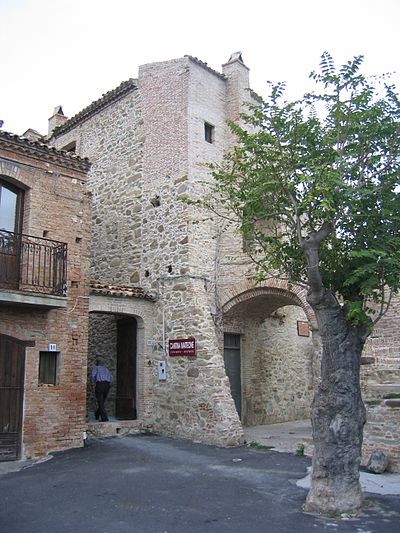 The paese pays homage to their famous guest, who championed their cause, with numerous namings in his honor - a street, piazza, coffee bar, restaurant all bear his name. A statue of him stands at the entrance to town. Aliano is considered a "literary park," with placques affixed to buildings with quotes in Levi's words as he had described each landmark in his book, so visitors can tour the town and see it through his eyes and words.
The house of his interment has been turned into a museum. Many of his paintings are on display in the Museo della Civilta` Contadina (Museum of Peasant Culture).
It was Carlo Levi's request to be buried in Aliano and his grave lies in a panoramic spot in the cemetary, up above the village. It is sprinkled with pebbles left by visitors to show how beloved he was. Aliano is isolated on top of a hill with commanding views of the weirdly-eroded countryside and surrounding mountains. The town has come a long way since their illustrious guest came to stay, but the timelessness of their traditions and the splendor of their natural surroundings are unchanged. Nor is their affection for the man who served them so well and continues to impact their well-being.
All rights reserved. Valerie Schneider 2009
Aliano seems to bask in its infamy. Seventy years ago it had been a typical peasant village in remote southern Basilicata, scraping to survive, and ignored and derided by the central government. It would have remained hidden and forgotten in its lunar-like hills had it not been paid a visit by destiny.
When the Mussolini government wanted to silence the political writings and rabble-rousings of a Jewish doctor and anti-fascist named Carlo Levi, it could think of no punishment more severe than banishment from his northern city of Torino to the hinterlands of Basilicata. Modern communications and northern news filtered very slowly- if at all- from there, so Levi and his inflammatory activism would be safely out of their dictatorial hair.Levi arrived in Aliano to find an abject poverty in stark contrast of his prosperous north, which seemed a world away. The remote locale was neglected and remained outside of time while resources were focused on northern industrial technologies and interests. Levi spent his two years of political exile acting as town physician while painting local scenes and characters and taking detailed journalistic notes which he would use to write his well-known book, Christ Stopped at Eboli. From his house on the edge of the village, Levi observed, interacted with, tended to, painted, and chronicled the life, hardships, and contrasts of a place within his own country that was foreign to him.
When he was released from his house arrest, Levi penned his most famous work, which shed light on the political, economic and social problems of the south, and would eventually bring attention and change to the region. And the town of Aliano could not have been more grateful.Today, Aliano is still small and still remote, but the appearance, well-being, and status of the town is very different thanks to Levi, whose writings and presence continue to live on there. Many of the buildings have been spruced up and restructured, with more work obviously underway. The place looks tended to and cared for, unlike the descriptions of squalor that Levi chronicled upon his arrival. Inhabitants stroll the streets, gather in the piazza and coffee bars, smiling their friendly greetings at visitors. Tourists from across Italy come to see it, and cars bearing license plates from other European countries are parked in the municipal lot.
The paese pays homage to their famous guest, who championed their cause, with numerous namings in his honor - a street, piazza, coffee bar, restaurant all bear his name. A statue of him stands at the entrance to town. Aliano is considered a "literary park," with placques affixed to buildings with quotes in Levi's words as he had described each landmark in his book, so visitors can tour the town and see it through his eyes and words.The house of his interment has been turned into a museum. Many of his paintings are on display in the Museo della Civilta` Contadina (Museum of Peasant Culture).
It was Carlo Levi's request to be buried in Aliano and his grave lies in a panoramic spot in the cemetary, up above the village. It is sprinkled with pebbles left by visitors to show how beloved he was.
Aliano is isolated on top of a hill with commanding views of the weirdly-eroded countryside and surrounding mountains. The town has come a long way since their illustrious guest came to stay, but the timelessness of their traditions and the splendor of their natural surroundings are unchanged. Nor is their affection for the man who served them so well and continues to impact their well-being.All rights reserved. Valerie Schneider 2009
Wednesday, June 24, 2009
The Lost Leonardo
Acerenza is a pretty place. Set up on a massif high at the end of a squiggly road, its position above the Bradano River has been enviable and strategic since before the Roman age. It has seen -and survived- many invaders through the millennia, but like many towns in this area it was the Middle Ages that left the most lasting features on Acerenza, endowing it with narrow pedestrian lanes and petite but appealing palazzi. Parts of the protective walls, punctuated with guardly gates, still cradle the compact centro storico. Captivating vistas are revealed from every overlook.
During the Renaissance period Acerenza was passed around as a baron's trophy, handed off from one noble family to another. Naturally, aristocrats ran in the same circles and entertained dignitaries and luminaries from other regions.
 So what, you say? Well, a particular noble family who transferred to Acerenza from Florence had a famous friend, Leonardo da Vinci.
It was already known that the Segni family had been in possession of a Leonardo drawing of Neptune, a token from their artist-friend to Antonio Segni as a parting gift. When a historian named Barbitelli was conducting research in Acerenza and came across a painting that the current owners had always believed was a portrait of Galileo, he saw a striking similarity to a portrait of Leonardo in the Uffizi as well as what is believed to be a self-portrait in Torino, and remembered the family's friendship with the artist. When he saw an inscription on the back written backwards as Leonardo preferred to sign his works, he was convinced this was a lost Leonardo - not a mere portrait of the legendary man, but one created by his own hand.
So went the captivating narrative proudly proclaimed to us by a barista in Acerenza during our visit. He told us that experts from the art world as well as the authorities at the Leonardo museum in Vinci had authenticated the painting. All of Acerenza was buzzing about it, not just because it had been discovered in their town, but because somehow it had been swiped out from under them and put on display in a museum in nearby Vaglio instead of in Acerenza itself. The injustice! railed our barista (along with a few choice words about the politicians and fools who allowed it to happen).
Seeing as we were in the area and Vaglio was located only about thirty kilometers from our lodgings, we decided to head over and see the exhibit. Finding information on the museum and opening hours proved a little more difficult than you would think, considering they were currently caching a treasure that rocked the art world. We finally located a brochure on the Museo delle Antiche Genti Lucane, which they had translated into English as "The Museum of the Old People," which conjured up a vision of a room of old folks in rocking chairs, instead of a display of ancient artifacts.
Vaglio, in contrast to attractive Acerenza, was a fairly depressing paese that retained little of its historic charm and looked mostly rebuilt in concrete. The museum was likewise fashioned from cement, gated and fenced in such a way that it resembled a penitentiary. What was purported to be "the" museum on the ancient Lucani housed a rather meager medley of artifacts and somewhat cheesey reconstructions. We forked over fourteen euros (each) to peer at the painting (twice what we would have paid to enter the famed Uffizi!)
The discovery was recent and the exhibit was hastily assembled. Other portraits, prints, and documents from various sources, including the Leonardo museum, built a strong case to convince the viewer that this painting was the real deal. We jockeyed for position, being jabbed by elbows of cell phone photographers and inattentive patrons. A blustery academic pushed us over so he could stand front and center while lecturing monotonously to a handful of students who took no interest in his lengthy and obviously boring discourse.

Finally we were able to stand before the poorly displayed portrait. Lighting was misplaced and glared off the protective glass. We had to move around, backwards and forwards to get a good angle to compensate for the blur. The image of a middle-aged man with flowing auburn hair and a billowy beard was painted on wood, and was scratched and pocked. Blueberry eyes peered out and followed our movements.
Overall we felt a little cheated. The poor quality of the exhibit and second-rate lighting and display of this precious piece certainly dulled our experience. But we were impressed with the evidence that it is, in fact, of Leonardo, and based on the other sketches, are inclined to believe that it was a self-portrait. And it was pretty exciting to see it, since few people had even heard of its discovery - yet here it was tucked away in a forgotten town in Basilicata. I just hope it can ultimately return to Acerenza. It would definitely be more cherished and charmingly-displayed in that lovely village.
 This portrait from the Biblioteca Reale di Torino is widely thought to be a self-portrait of Leonardo, too. There are certainly some interesting similarities.
Raphael's famous fresco in the Vatican, The School of Athens, is also said to contain a depiction of Leonardo, standing in as Plato.
For fun, watch this video of Leonardo da Vinci's Paintings of Women.
During the Renaissance period Acerenza was passed around as a baron's trophy, handed off from one noble family to another. Naturally, aristocrats ran in the same circles and entertained dignitaries and luminaries from other regions.
So what, you say? Well, a particular noble family who transferred to Acerenza from Florence had a famous friend, Leonardo da Vinci.It was already known that the Segni family had been in possession of a Leonardo drawing of Neptune, a token from their artist-friend to Antonio Segni as a parting gift. When a historian named Barbitelli was conducting research in Acerenza and came across a painting that the current owners had always believed was a portrait of Galileo, he saw a striking similarity to a portrait of Leonardo in the Uffizi as well as what is believed to be a self-portrait in Torino, and remembered the family's friendship with the artist. When he saw an inscription on the back written backwards as Leonardo preferred to sign his works, he was convinced this was a lost Leonardo - not a mere portrait of the legendary man, but one created by his own hand.
So went the captivating narrative proudly proclaimed to us by a barista in Acerenza during our visit. He told us that experts from the art world as well as the authorities at the Leonardo museum in Vinci had authenticated the painting. All of Acerenza was buzzing about it, not just because it had been discovered in their town, but because somehow it had been swiped out from under them and put on display in a museum in nearby Vaglio instead of in Acerenza itself. The injustice! railed our barista (along with a few choice words about the politicians and fools who allowed it to happen).
Seeing as we were in the area and Vaglio was located only about thirty kilometers from our lodgings, we decided to head over and see the exhibit. Finding information on the museum and opening hours proved a little more difficult than you would think, considering they were currently caching a treasure that rocked the art world. We finally located a brochure on the Museo delle Antiche Genti Lucane, which they had translated into English as "The Museum of the Old People," which conjured up a vision of a room of old folks in rocking chairs, instead of a display of ancient artifacts.
Vaglio, in contrast to attractive Acerenza, was a fairly depressing paese that retained little of its historic charm and looked mostly rebuilt in concrete. The museum was likewise fashioned from cement, gated and fenced in such a way that it resembled a penitentiary. What was purported to be "the" museum on the ancient Lucani housed a rather meager medley of artifacts and somewhat cheesey reconstructions. We forked over fourteen euros (each) to peer at the painting (twice what we would have paid to enter the famed Uffizi!)
The discovery was recent and the exhibit was hastily assembled. Other portraits, prints, and documents from various sources, including the Leonardo museum, built a strong case to convince the viewer that this painting was the real deal. We jockeyed for position, being jabbed by elbows of cell phone photographers and inattentive patrons. A blustery academic pushed us over so he could stand front and center while lecturing monotonously to a handful of students who took no interest in his lengthy and obviously boring discourse.

Finally we were able to stand before the poorly displayed portrait. Lighting was misplaced and glared off the protective glass. We had to move around, backwards and forwards to get a good angle to compensate for the blur. The image of a middle-aged man with flowing auburn hair and a billowy beard was painted on wood, and was scratched and pocked. Blueberry eyes peered out and followed our movements.
Overall we felt a little cheated. The poor quality of the exhibit and second-rate lighting and display of this precious piece certainly dulled our experience. But we were impressed with the evidence that it is, in fact, of Leonardo, and based on the other sketches, are inclined to believe that it was a self-portrait. And it was pretty exciting to see it, since few people had even heard of its discovery - yet here it was tucked away in a forgotten town in Basilicata. I just hope it can ultimately return to Acerenza. It would definitely be more cherished and charmingly-displayed in that lovely village.
This portrait from the Biblioteca Reale di Torino is widely thought to be a self-portrait of Leonardo, too. There are certainly some interesting similarities.Raphael's famous fresco in the Vatican, The School of Athens, is also said to contain a depiction of Leonardo, standing in as Plato.
For fun, watch this video of Leonardo da Vinci's Paintings of Women.
Subscribe to:
Posts (Atom)


 Posts
Posts


