I've been feeling a little melancholy this week. I've been thinking a lot about my grandpa and feeling his absence. I wish I could call and say hello...hear him say that he's "fit as a fiddle". I am wishing I could have seen him one last time. Maybe this melancholy is because of Father's Day, when I would have called him, when I pause to be thankful for the men who provided stability and assurance in my life. Maybe it's just the permanence of his absence settling on me that is making me feel a little misty. Or maybe it's my choice of reading material.
After my grandpa died, we moved Grams into a smaller apartment. When we were cleaning the old apartment my mom came across a stack of books, piled in a closet. "OH MY!," she exclaimed. "Mom's journals!" The pile of books with Year Book proclaimed in gold lettering on each dated mostly from the late 60s and 70s. This was a revelation to me; I had not known that for most of her adult life my grandma kept these diaries. All those years, seeing them so frequently, spending countless nights at their house...yet I had never seen these numerous leather-bound books before.
It has been interesting reading.
She wrote very dispassionately. These diaries are not a compilation of her thoughts, dreams or heart-aches. She wrote, instead, of her day. Every day. For years. The activities of the family members; what chores or activities she performed each day; where she walked; who she wrote letters to or received letters from; who visited. The picture that emerged of my grandma's life is drawn in bold lines, a black and white sketch, the color and depth of emotions are not brushed into the portrait.
She did write of her worries -occasionally- usually involving one of her children. Dean seems to be working too hard, making himself sick; Roger is having problems at school; Judy is having tremendous headaches. These statements seemed to be written out of helplessness to do much, and my grandma didn't like being helpless.
Her own activities were recorded. She baked bread three times a week for 50 years. Never learning to drive, she walked everywhere she needed to go - and often bummed rides home. "Walked to the library, got a ride home from Flossie." Everything she needed was in reach. She could walk uptown and have breakfast, buy a shirt, shop for a washing machine, stop at the grocery store on the way home. The small town had all she needed. Her journals portray a way of life that -in just a few short decades - has largely slipped away. Now we drive everywhere, Main Street no longer has a department store or appliance store and precious few places for dining and gathering, either. It seems that life was spent, rather than consumed. And she seemed content.
My grandpa worked two jobs with an occasional third job, too. He worked hard. But so did my grandma. She scrubbed, cooked, ironed piles of clothes - her own family's and others'- and washed using her old wringer washing machine, then hung the clothes outside to dry. She took us grandkids to give my mom a break. She baked cookies or pies or cakes, every day. She mended clothes. She played with us grandkids. She allowed herself an indulgence - after lunch she sat down and watched her "program". Every day. For years.
Her greatest joys were found in the simplest pleasures - a picnic, a phone call or card received in the mail, a card game with friends, a visit to family members on a farm, a snowball fight. She loved a country drive and a stop for ice cream on the way home.
The most striking thing that emerged as I read several years' worth of her daily activities was the fact that she did something for someone else every single day of her life. Baking bread, making meals, cleaning a house, writing letters. Cleaning the church linen, visiting invalid nuns, helping at the nursing home. Every day. For years. She took meals to one family daily for more than six months. She looked in on another elderly lady and visited with her, cleaned her house, weeded her flower beds. She cared for an elderly and senile aunt who became nasty and spiteful toward my grandma, yet Grams continued and wrote that "Aunt Elsie didn't know what she was doing." Grams recognized the needs of the person behind the facade. It upset her, yet she gave her all. She was involved in her community and in her church. She cared for the people around her. It was a part of her day. Every day. For years.
Her fulfillment came from helping others and caring for her family. Every day. She spent her energies, she invested herself. She cared. She had a servant's heart. She did all these things despite regular pain and fatigue. She often wrote that her "hip hurt something awful", yet she cooked and delivered meals. She frequently said she was "so tired", yet she scrubbed the floors and organzined meetings for the Altar Society.
These are the things my grandma recorded - daily life, as it was. I'm glad she did. I see her now, at nearly 95 being cared for, her investments yielding a return. Yet I wonder if she looks around and wishes she were helping rather than being helped. It was, after all, her way of life. Every day. For years.
copyright 205 Valerie Schneider
Thursday, June 23, 2005


Thursday, June 16, 2005
Critter Update
Because several people have inquired after the wildlife, I want to reassure you that - to our surprise - they have continued to visit. The baby quail are growing very quickly and seem unimpressed and nonplussed by the racket and earth-shaking going on next door. Yesterday morning they came despite the huge front-end loader. The mama seemed a bit nervous and kept a vigilant eye, but the chicks hopped happily about eating ants. We were able to witness their flight lessons. Mama flew up onto the wooden frame surrounding the compost and bid her birdies to follow. She half-flew/half-jumped and the chicks followed, some more reluctantly than others.
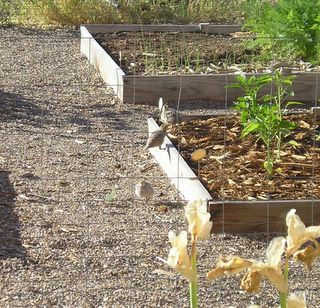
Quail chicks in the garden. Yes, I know they're hard to see with the gray stone.
The bunnies, too, are still habitually hopping by to see us (or rather, for us to see them). We actually seem to have more bunnies than before and we think that their habitat was destroyed when the sage was torn out next door. Suddenly instead of just three, we've been seeing five, and there seems to be a bit of a territorial issue going on. One will be at the water dish or munching carrot trimmings when another will hop down the path. The first one jumps, slicks back his ears, and chases the intruder off. Then another one comes and scares of the first bunny. We have been amused and entertained by them.
So yes, the critters continue to be as amusing as ever. And the construction next door continues to be as loud and obnoxious as ever. But that's another story.

Rabbit reposing on the pathway, with another bunny in the background.

Chicks and mama quail, with a bunny at the water dish (darn that gray stone!)

Quail chicks in the garden. Yes, I know they're hard to see with the gray stone.
The bunnies, too, are still habitually hopping by to see us (or rather, for us to see them). We actually seem to have more bunnies than before and we think that their habitat was destroyed when the sage was torn out next door. Suddenly instead of just three, we've been seeing five, and there seems to be a bit of a territorial issue going on. One will be at the water dish or munching carrot trimmings when another will hop down the path. The first one jumps, slicks back his ears, and chases the intruder off. Then another one comes and scares of the first bunny. We have been amused and entertained by them.
So yes, the critters continue to be as amusing as ever. And the construction next door continues to be as loud and obnoxious as ever. But that's another story.

Rabbit reposing on the pathway, with another bunny in the background.

Chicks and mama quail, with a bunny at the water dish (darn that gray stone!)
Thursday, June 09, 2005
Backyard Wildlife
A scene has been playing out daily this past week as I awake and go into the kitchen for my morning coffee. I peek out the window and see a bevy of infant quail in my garden, their mama hovering over them. The little aviary fluff-balls squeak and hop around merrily, digging their little beaks into the sand to find their buggy breakfast. There are thirteen of them. The sole adult female stands guard on the gate, then hops down into the garden for a bite or two herself. When the babies have satisfied their hunger, they scurry out the rabbit fence into the sagebrush. The mama bird, however, is quick to forget that she has wings and, in a panic, runs along the fence, pecking at the grating, throwing herself against it, trying to exit in the manner her little flock did. Eventually she remembers her flight capabilities and makes a hop over the barrier to her waiting chicks.
In addition to the adorable avians, we have a few cute cottontail rabbits who routinely visit, looking for scraps from the garden and to drink from the water dish we've put out to attract such creatures. One of these, also, is a baby bunny and hops around in circles between the water dish and the carrot scraps, as if undecided which he wants first. Once the carrots win over, he nibbles nimbly away at the stalk and orange flesh, lifting his head to look around from time to time, skiddish to any sound that will cause him to high-tail it into the brush.
We also have a fair share of roadrunners -our state bird- coming to torment Winston, the birds seemingly knowing that he is too old and unable to jump very high to pursue them, they perch on the courtyard wall and cause him to emit his "kitty chatter" and slump down in a pounce position, which never changes into an actual pounce. The roadrunner are as large as him, in any case, and he probably wouldn't have pounced even in his younger days.
These backyard wildlife viewings have suddenly, we fear, been eliminated due to a new, more beastly invasion: construction on the lot next door. We've known that a house would be built there, and we've been fortunate that in our nine years of residence in Corrales we've not had this ordeal sooner. It began with a large well-drilling truck churning up a racket on Tuesday. Wednesday brought a huge front-end loader which was noisily used to begin digging a gigantic hole, the purpose of which we can't imagine. Basements are practically non-existant in New Mexico, as are crawl spaces. No other builders in our area (that we've seen, and lots of homes have gone up since we've moved here) dig out large expanses such as this. Last night the noise blessedly stopped at about 5:20 p.m. so we started dinner and set the table outside. The moment - honestly, the very instant- I brought out the food, a worker returned to the big water truck, started up the rumbling diesel engine and proceeded to wet down the big pile of dirt. This morning, instead of the usual chirps and calls of the birds to awaken us, the whining drone of the front-end loader began at 6:40 a.m. Thank you so much.
This wouldn't be so bad (though I do dislike mechanical wake-up calls before 7:30 a.m.) were it not for the manner in which it all started. The builder staked out the lot about two weeks ago, and we winced. The stakes, indicating the position of the gigantic home to be built, also indicated that our view would be decimated. We were, naturally, disheartened and displeased. Knowing that the subdivision has covenants in place and that plans have to be submitted to an architectural committee for review, though, we waited, hoping. One of the three committee members came out to the lot with the plans and surveyed. He walked all over, from stake to stake, while consulting the builder's plans. He recommended moving the structure 20 feet south, which he said would not impact their views at all because of window orientation, but would help our views quite a bit. The builder informed him that the buyers refused. They wanted the view they wanted, and that was it. They hadn't even considered that a home was already in place behind them. Or they just didn't care. Back and forth we went with the poor committee member - a neighbor - in the middle. It looked as if the only way to preserve any semblance of a view would be to obtain an injunction and then sue. Not something we wanted to do for many reasons, including cost. Eventually the builder convinced the buyer to move the structure 10 feet south. Oh, thank you generous buyers, I say tongue-firmly-in-cheek. We're not unrealistic, we knew our view wouldn't be what it has been for nine years and that it would be partially obstructed. But the audacity to plop their monstrosity directly in front of every single one of our windows irked me tremendously. We are so looking forward to living next to these affable, neighborly people.
Our friends and family have been offering helpful advice:
"Get yourself a nice, noisy rooster."
"Put in a pig pen right on the lot line and upwind. I think Bryan would make a good pig farmer!"
"Ask the neighbors on the other side of them to erect a very high fence."
"Invite your electric guitar-playing brother for a loud visit."
All tempting suggestions.
We are anticipating five to six months of construction noise. In the meantime, we wonder what will become of our fluff-ball quail babies and bunny visitors. We rather enjoyed our backyard wildlife. I hope they're smart enough to scurry around to the front yard, where there are no gaping holes or noisy mechanical things devouring their habitat. If not, it may be rather lonely out here on the mesa. They sure have been better, friendlier neighbors than the ones moving in.
copyright 2005 Valerie Schneider
In addition to the adorable avians, we have a few cute cottontail rabbits who routinely visit, looking for scraps from the garden and to drink from the water dish we've put out to attract such creatures. One of these, also, is a baby bunny and hops around in circles between the water dish and the carrot scraps, as if undecided which he wants first. Once the carrots win over, he nibbles nimbly away at the stalk and orange flesh, lifting his head to look around from time to time, skiddish to any sound that will cause him to high-tail it into the brush.
We also have a fair share of roadrunners -our state bird- coming to torment Winston, the birds seemingly knowing that he is too old and unable to jump very high to pursue them, they perch on the courtyard wall and cause him to emit his "kitty chatter" and slump down in a pounce position, which never changes into an actual pounce. The roadrunner are as large as him, in any case, and he probably wouldn't have pounced even in his younger days.
These backyard wildlife viewings have suddenly, we fear, been eliminated due to a new, more beastly invasion: construction on the lot next door. We've known that a house would be built there, and we've been fortunate that in our nine years of residence in Corrales we've not had this ordeal sooner. It began with a large well-drilling truck churning up a racket on Tuesday. Wednesday brought a huge front-end loader which was noisily used to begin digging a gigantic hole, the purpose of which we can't imagine. Basements are practically non-existant in New Mexico, as are crawl spaces. No other builders in our area (that we've seen, and lots of homes have gone up since we've moved here) dig out large expanses such as this. Last night the noise blessedly stopped at about 5:20 p.m. so we started dinner and set the table outside. The moment - honestly, the very instant- I brought out the food, a worker returned to the big water truck, started up the rumbling diesel engine and proceeded to wet down the big pile of dirt. This morning, instead of the usual chirps and calls of the birds to awaken us, the whining drone of the front-end loader began at 6:40 a.m. Thank you so much.
This wouldn't be so bad (though I do dislike mechanical wake-up calls before 7:30 a.m.) were it not for the manner in which it all started. The builder staked out the lot about two weeks ago, and we winced. The stakes, indicating the position of the gigantic home to be built, also indicated that our view would be decimated. We were, naturally, disheartened and displeased. Knowing that the subdivision has covenants in place and that plans have to be submitted to an architectural committee for review, though, we waited, hoping. One of the three committee members came out to the lot with the plans and surveyed. He walked all over, from stake to stake, while consulting the builder's plans. He recommended moving the structure 20 feet south, which he said would not impact their views at all because of window orientation, but would help our views quite a bit. The builder informed him that the buyers refused. They wanted the view they wanted, and that was it. They hadn't even considered that a home was already in place behind them. Or they just didn't care. Back and forth we went with the poor committee member - a neighbor - in the middle. It looked as if the only way to preserve any semblance of a view would be to obtain an injunction and then sue. Not something we wanted to do for many reasons, including cost. Eventually the builder convinced the buyer to move the structure 10 feet south. Oh, thank you generous buyers, I say tongue-firmly-in-cheek. We're not unrealistic, we knew our view wouldn't be what it has been for nine years and that it would be partially obstructed. But the audacity to plop their monstrosity directly in front of every single one of our windows irked me tremendously. We are so looking forward to living next to these affable, neighborly people.
Our friends and family have been offering helpful advice:
"Get yourself a nice, noisy rooster."
"Put in a pig pen right on the lot line and upwind. I think Bryan would make a good pig farmer!"
"Ask the neighbors on the other side of them to erect a very high fence."
"Invite your electric guitar-playing brother for a loud visit."
All tempting suggestions.
We are anticipating five to six months of construction noise. In the meantime, we wonder what will become of our fluff-ball quail babies and bunny visitors. We rather enjoyed our backyard wildlife. I hope they're smart enough to scurry around to the front yard, where there are no gaping holes or noisy mechanical things devouring their habitat. If not, it may be rather lonely out here on the mesa. They sure have been better, friendlier neighbors than the ones moving in.
copyright 2005 Valerie Schneider
Tuesday, May 31, 2005
Drinking The Rio
Embarking on a Sunday’s adventure rafting on the Rio Grande gave us more thrills and chills than we anticipated. We underestimated the forthcoming rapids based on previous trips down the river. The Rio Grande is running at speeds and depths unheard of in many years. The end of our long drought cycle has resulted in record snow-melt, feeding the Rio with staggering amounts of water. The river banks are higher, areas that formally were beaches are under water, and the rapidity of the flow is amazing. On the drive through the Taos Gorge we saw many cars parked along the highway, the spectators standing on the cliff watching rafters below, a day’s entertainment for the local folks.
The trip began with paddling lessons, cinching us tightly into life vests, cautions from our two guides about how we would approach upcoming series of rapids, and assurances of an exciting trip. We had, they warned, a one-in-three chance of flipping or falling out on the final rapid, but they would instruct us further before we approached that one. We hit the first series of rapids whooping and hollering; we were fired up. We anticipated the next series of whitewater gleefully. The six of us were in sync, paddling efficiently, working as a team. The guides complimented us. We beamed and laughed and made merry.
Halfway through our trip we came upon a wooden bridge suspended over the river. Normally the clearance below the bridge is roomy enough to sail under; today because the water levels were so lofty, to pass under we had to paddle to the far left, a guide outside the raft pulling us through, as we leaned down and ducked below. With that obstacle past and our confidence bolstered in our teamwork, we proceeded down the river toward the last two sets of rapids, enjoying the vistas, the bright blue sky, and the sweet aroma of the Russian Olive trees.
We coursed through the rough so-called Sleeping Beauty rapids wet but elated. Our guide gave us more last-minute instructions on the upcoming and major final rapid, Souse Hole. A hole it was…a hell hole. As we approached around a bend our guide told us to cast our eyes forward and watch the raft ahead of us as it disappeared down what we river amateurs oh-so-mistakenly thought was a waterfall leading into a long set of rapids. We followed the instructions as they were screamed out to us: “Right back paddle, forward paddle, paddle, paddle, paddle!” We dropped into the mother of all rapids, into a gaping hole in the river. We were swallowed by the Rio Grande. And we all swallowed a lot of the Rio in turn.

In a moment scenes unfolded: the left side of the raft lifted off the surface. Diane tipped backwards off the raft. Cara flew across the raft head-first into the surging swells. Brian, Diane’s husband, plopped out. Water was overhead and crashing down upon us. My thoughts scattered and awareness of events unfolding registered all at once, like rapid-fire photographs in succession: oh my God, we’re going to flip over; crap, Diane fell out; holy cow, Cara sailed past me; an awareness of fear; water is pounding over top of me; who else is missing; I am the only one left on my side of the raft so I need to paddle for all I’m worth; the guide is climbing over me; I am hearing screaming; where is Diane…she’s over there and there is terror on her face; thank God, Bryan is still next to me. All these thoughts occurred in an instant. The raft was still rocking, surging, flowing quickly. There was, it seemed in that instant, carnage all around me, and the water kept swelling.
The final awareness settled on me and calmed me: we were all safe. Diane was pulled into another raft, the woman guide soothing her and yanking her up by her life vest, telling her that she was okay. Cara and Brian were on the rocks, gulping and gasping for air after the exertion and the huge quantities of water they had swallowed. Bryan, Eric and I, along with the second guide paddled and heaved up along the rocky shoreline to reach them. The first guide had jumped over me, jumped to the rocks and pulled us along. It was at once harrowing and exhilarating, frightening and thrilling.
It all unfolded in a matter of seconds, and then minutes. We were alright; we were all back on the raft. Diane was shaking and crying and hugging her husband and son. Cara was still sputtering mouthfuls of the Rio Grande. The guides encouraged and comforted us and then, when we were ready for it, laughed about the adventure. We hadn’t flipped over and that was an accomplishment.
We all swallowed more of the river than we desired. Diane, the moment she re-entered our raft said, “I need a drink!” Indeed! Margaritas would be sought out once we were dry. But first we drove to the overlook where we’d seen the spectators. Now that we knew what they were gawking at, we wanted to see the wrecking scene, to view from above what exactly we had gone through. The gaping hole and the force of the rapids astounded us. We watched rafts come through, the first overturned head to tail, all the occupants spilled and scattered in the water. We gasped, and then we were thankful that we had not flipped over completely.
Today we are sore, our varying degrees of battle wounds. We are recounting the details, over and over, comparing our mental notes and impressions, looking at the photos, reliving the scenes, continuously amazed by our experience, glad we had such a thrilling ride, glad we were okay. We drank from the Rio Grande and it tasted bitter-sweet. But it was intoxicating.
copyright 2005 Valerie Schneider
The trip began with paddling lessons, cinching us tightly into life vests, cautions from our two guides about how we would approach upcoming series of rapids, and assurances of an exciting trip. We had, they warned, a one-in-three chance of flipping or falling out on the final rapid, but they would instruct us further before we approached that one. We hit the first series of rapids whooping and hollering; we were fired up. We anticipated the next series of whitewater gleefully. The six of us were in sync, paddling efficiently, working as a team. The guides complimented us. We beamed and laughed and made merry.
Halfway through our trip we came upon a wooden bridge suspended over the river. Normally the clearance below the bridge is roomy enough to sail under; today because the water levels were so lofty, to pass under we had to paddle to the far left, a guide outside the raft pulling us through, as we leaned down and ducked below. With that obstacle past and our confidence bolstered in our teamwork, we proceeded down the river toward the last two sets of rapids, enjoying the vistas, the bright blue sky, and the sweet aroma of the Russian Olive trees.
We coursed through the rough so-called Sleeping Beauty rapids wet but elated. Our guide gave us more last-minute instructions on the upcoming and major final rapid, Souse Hole. A hole it was…a hell hole. As we approached around a bend our guide told us to cast our eyes forward and watch the raft ahead of us as it disappeared down what we river amateurs oh-so-mistakenly thought was a waterfall leading into a long set of rapids. We followed the instructions as they were screamed out to us: “Right back paddle, forward paddle, paddle, paddle, paddle!” We dropped into the mother of all rapids, into a gaping hole in the river. We were swallowed by the Rio Grande. And we all swallowed a lot of the Rio in turn.
In a moment scenes unfolded: the left side of the raft lifted off the surface. Diane tipped backwards off the raft. Cara flew across the raft head-first into the surging swells. Brian, Diane’s husband, plopped out. Water was overhead and crashing down upon us. My thoughts scattered and awareness of events unfolding registered all at once, like rapid-fire photographs in succession: oh my God, we’re going to flip over; crap, Diane fell out; holy cow, Cara sailed past me; an awareness of fear; water is pounding over top of me; who else is missing; I am the only one left on my side of the raft so I need to paddle for all I’m worth; the guide is climbing over me; I am hearing screaming; where is Diane…she’s over there and there is terror on her face; thank God, Bryan is still next to me. All these thoughts occurred in an instant. The raft was still rocking, surging, flowing quickly. There was, it seemed in that instant, carnage all around me, and the water kept swelling.
The final awareness settled on me and calmed me: we were all safe. Diane was pulled into another raft, the woman guide soothing her and yanking her up by her life vest, telling her that she was okay. Cara and Brian were on the rocks, gulping and gasping for air after the exertion and the huge quantities of water they had swallowed. Bryan, Eric and I, along with the second guide paddled and heaved up along the rocky shoreline to reach them. The first guide had jumped over me, jumped to the rocks and pulled us along. It was at once harrowing and exhilarating, frightening and thrilling.
It all unfolded in a matter of seconds, and then minutes. We were alright; we were all back on the raft. Diane was shaking and crying and hugging her husband and son. Cara was still sputtering mouthfuls of the Rio Grande. The guides encouraged and comforted us and then, when we were ready for it, laughed about the adventure. We hadn’t flipped over and that was an accomplishment.
We all swallowed more of the river than we desired. Diane, the moment she re-entered our raft said, “I need a drink!” Indeed! Margaritas would be sought out once we were dry. But first we drove to the overlook where we’d seen the spectators. Now that we knew what they were gawking at, we wanted to see the wrecking scene, to view from above what exactly we had gone through. The gaping hole and the force of the rapids astounded us. We watched rafts come through, the first overturned head to tail, all the occupants spilled and scattered in the water. We gasped, and then we were thankful that we had not flipped over completely.

Today we are sore, our varying degrees of battle wounds. We are recounting the details, over and over, comparing our mental notes and impressions, looking at the photos, reliving the scenes, continuously amazed by our experience, glad we had such a thrilling ride, glad we were okay. We drank from the Rio Grande and it tasted bitter-sweet. But it was intoxicating.
View Photos of the trip.
Article about Souse Hole
Definition/Description of a river souse hole
copyright 2005 Valerie Schneider
Wednesday, May 25, 2005
The Air Up Here
This week has been a flurry of activity. My parents were in town for several days to assist my sister with her kitchen remodeling project (detailed in Madame Foreperson), and Bryan and I spent a lot of time lending hands and sweat as well. And I do mean sweat. It has been warmer than normal for this time of year, already in the mid 90s. My parents departed Monday and I've been preparing for the next round of company. My sister-in-law Diane is arriving tomorrow with her husband and son. We're very much looking forward to their visit. I've been busily cleaning the house in preparation, all the chores I'd put off to work on Cara's kitchen have been pushed to the front burner. I've been dusting the sand that the winds have blown in, and cleaning the guest tub of the cat hair Winston has deposited there. In the heat he likes to lay on the cool tub surface. Unfortunately, his dark fur leaves tell-tale evidence of his respites there.
We're ready for their arrival, with lots of activities planned for their short visit. My main concern is their ability to handle the heat and the altitude. As I mentioned, it has already been warmer than normal. I don't mind myself as the heat really doesn't bother me until we hit about 98. Then I feel it and get a bit cranky. But they may not adapt so easily, coming from the barely-thawed Upper Midwest. And I am also concerned about Altitude Sickness, since sea-level dwellers coming rapidly to a mile-high elevation often experience problems. Also referred to as Acute Mountain Sickness (AMS), the symptoms usually include shortness of breath and light-headedness. One medical website says, "Most people experience the symptoms of AMS in the first three days after arrival. The symptoms usually go away by the fourth day." Great, they'll be here for five days, so they will be acclimitized just in time to board the plane for home!
We had an in-your-face reminder of the ills of Altitude Sickness at Christmas when my brother turned wretchedly sick after a day of skiing, the combination of exertion, dehydration and high altitude proving miserable; he vomited, experienced muscle aches and weakness, and had chills. It was a potent reminder to us that the air we so take for granted really is thinner, and while we're used to it, I have been reminded that we, too have sometimes had to suck wind when hiking in the higher mountain ranges. So how much more the low-landers who will be arriving?
We'll have to take it easy on them for the first day, but after that they will need to acclimate; there are too many fun things to do and so little time. So Diane, if you're reading this, here is the medical advice for avoiding altitude sickness: rest up, start drinking lots of water now to stay hydrated, avoid alcohol and eat lots of carbs. Oh, and practice deep breathing. Remember, the air is thinner up here.
copyright 2005 Valerie Schneider
We're ready for their arrival, with lots of activities planned for their short visit. My main concern is their ability to handle the heat and the altitude. As I mentioned, it has already been warmer than normal. I don't mind myself as the heat really doesn't bother me until we hit about 98. Then I feel it and get a bit cranky. But they may not adapt so easily, coming from the barely-thawed Upper Midwest. And I am also concerned about Altitude Sickness, since sea-level dwellers coming rapidly to a mile-high elevation often experience problems. Also referred to as Acute Mountain Sickness (AMS), the symptoms usually include shortness of breath and light-headedness. One medical website says, "Most people experience the symptoms of AMS in the first three days after arrival. The symptoms usually go away by the fourth day." Great, they'll be here for five days, so they will be acclimitized just in time to board the plane for home!
We had an in-your-face reminder of the ills of Altitude Sickness at Christmas when my brother turned wretchedly sick after a day of skiing, the combination of exertion, dehydration and high altitude proving miserable; he vomited, experienced muscle aches and weakness, and had chills. It was a potent reminder to us that the air we so take for granted really is thinner, and while we're used to it, I have been reminded that we, too have sometimes had to suck wind when hiking in the higher mountain ranges. So how much more the low-landers who will be arriving?
We'll have to take it easy on them for the first day, but after that they will need to acclimate; there are too many fun things to do and so little time. So Diane, if you're reading this, here is the medical advice for avoiding altitude sickness: rest up, start drinking lots of water now to stay hydrated, avoid alcohol and eat lots of carbs. Oh, and practice deep breathing. Remember, the air is thinner up here.
copyright 2005 Valerie Schneider
Tuesday, May 17, 2005
A Waste of a Perfectly Good Saturday
I don't know why, but for some inexplicable reason, when a neighbor mentioned to me that she was organizing a neighborhood-wide garage sale, I heard myself saying, "Great! We'll participate in that."
We are not "garage sale people". I haven't trudged out to one myself in nigh 15 years. We went to a few back when we were poor, starving students but almost always came away empty-handed and weary, so it was quickly abandoned for more productive pastimes, like hiking in the mountains. I never found anything I was looking for. "You can't go looking for something specific," one avowed garage saler told me. "You'll never find that one item. You have to go with your options open, that's when you find the deals." No, that was when I found things I couldn't figure out what I'd do with or why I'd have a need for them.
Not that I shouldn't be better at garage saling. My grandmother, bless her heart, organized and worked at countless rummage sales for her church, to benefit her local library, or who knows what other charities she was involved with, and spent days on end sorting and tagging items. She loved the notion of recycling goods and saving money, too. I can agree with the notion, it's just the practice of it that I have problems with. My mother, too, was adept at sales and furnished our home in beautiful antiques and china procured from estate sales, auctions and occasional garage sales. Timeless words of wisdom passed down to us kids, which we never forgot though we didn't necessarily heed: "Always shop the sales in the rich neighborhoods!"
The problem is I just don't have the stamina for it. These garage sale people are a different breed. They started circling in the cul de sac when I woke up at 7:00 a.m., looking for doors to open, waiting to pounce. Come on, I hadn't even had a cuppuccino yet! They arrived the moment the door was elevated, seeking specific items: "Do you have a TV?" No, at least not one that is for sale. "I'm looking for McDonald's Happy Meal toys". I haven't eaten in a McDonald's in at least six years and never ordered a Happy Meal when I did. "Don't you have children's toys or clothes?" Nope, no kids here, but can I interest you in a slightly used catnip chew toy Winston doesn't play with anymore? Then they were sprinting to their cars, off to ply the next neighbor with their questions. They would keep up this pace all day, or until they found those toys.
Some walked up the drive, took a quick look and then departed, not having turned off the pickup truck engine. Others came and talked my ear off, then departed. I didn't sell much. My poor sister sold even less, netting a whopping $2.50 from her haul. Maybe I should have consulted the many books and websites with advice on successful garage sales. Titles promise "maximum profits"; they offer "strategies" and "huge payoffs". One such site advised people to set up your garage like a store, mindful of traffic patterns and display. Yes I can see how that would be helpful: "You see, over here in this pile we have old junk. And over on that table is the older junk." Another site recommended playing soft background music to "set a mood conducive to shopping", and went on to offer specific selections of music that might put people into a buying mood. Other advice: offer bags for their purchases, greet each customer cheerfully when they enter, and provide free coffee. Hello, this is a garage sale not an upscale retail store! If I had retail saaviness, I'd be in business in a fixed location, not trying to hawk old, unwanted items out of my dusty car park.
There is, obviously, quite an interest in these kinds of sales. Why else would ebay be so popular or the Antique Road Show garner so many viewers? I can't figure out, though, if the interest is in collecting things and getting a deal, or in a lust for making a profit from things laying around your house. I'm sure there are psychology studies on this. As for me, I felt that the day was unproductive, that the paltry profit wasn't enough to induce me to spend another day of my life doing this again, and in the future, any accumulated belongings ready for recycling would be, as I have usually done in the past, donated to local charities and homeless shelters. My short-lived garage sale days are over.
copyright 2005 Valerie Schneider
We are not "garage sale people". I haven't trudged out to one myself in nigh 15 years. We went to a few back when we were poor, starving students but almost always came away empty-handed and weary, so it was quickly abandoned for more productive pastimes, like hiking in the mountains. I never found anything I was looking for. "You can't go looking for something specific," one avowed garage saler told me. "You'll never find that one item. You have to go with your options open, that's when you find the deals." No, that was when I found things I couldn't figure out what I'd do with or why I'd have a need for them.
Not that I shouldn't be better at garage saling. My grandmother, bless her heart, organized and worked at countless rummage sales for her church, to benefit her local library, or who knows what other charities she was involved with, and spent days on end sorting and tagging items. She loved the notion of recycling goods and saving money, too. I can agree with the notion, it's just the practice of it that I have problems with. My mother, too, was adept at sales and furnished our home in beautiful antiques and china procured from estate sales, auctions and occasional garage sales. Timeless words of wisdom passed down to us kids, which we never forgot though we didn't necessarily heed: "Always shop the sales in the rich neighborhoods!"
The problem is I just don't have the stamina for it. These garage sale people are a different breed. They started circling in the cul de sac when I woke up at 7:00 a.m., looking for doors to open, waiting to pounce. Come on, I hadn't even had a cuppuccino yet! They arrived the moment the door was elevated, seeking specific items: "Do you have a TV?" No, at least not one that is for sale. "I'm looking for McDonald's Happy Meal toys". I haven't eaten in a McDonald's in at least six years and never ordered a Happy Meal when I did. "Don't you have children's toys or clothes?" Nope, no kids here, but can I interest you in a slightly used catnip chew toy Winston doesn't play with anymore? Then they were sprinting to their cars, off to ply the next neighbor with their questions. They would keep up this pace all day, or until they found those toys.
Some walked up the drive, took a quick look and then departed, not having turned off the pickup truck engine. Others came and talked my ear off, then departed. I didn't sell much. My poor sister sold even less, netting a whopping $2.50 from her haul. Maybe I should have consulted the many books and websites with advice on successful garage sales. Titles promise "maximum profits"; they offer "strategies" and "huge payoffs". One such site advised people to set up your garage like a store, mindful of traffic patterns and display. Yes I can see how that would be helpful: "You see, over here in this pile we have old junk. And over on that table is the older junk." Another site recommended playing soft background music to "set a mood conducive to shopping", and went on to offer specific selections of music that might put people into a buying mood. Other advice: offer bags for their purchases, greet each customer cheerfully when they enter, and provide free coffee. Hello, this is a garage sale not an upscale retail store! If I had retail saaviness, I'd be in business in a fixed location, not trying to hawk old, unwanted items out of my dusty car park.
There is, obviously, quite an interest in these kinds of sales. Why else would ebay be so popular or the Antique Road Show garner so many viewers? I can't figure out, though, if the interest is in collecting things and getting a deal, or in a lust for making a profit from things laying around your house. I'm sure there are psychology studies on this. As for me, I felt that the day was unproductive, that the paltry profit wasn't enough to induce me to spend another day of my life doing this again, and in the future, any accumulated belongings ready for recycling would be, as I have usually done in the past, donated to local charities and homeless shelters. My short-lived garage sale days are over.
copyright 2005 Valerie Schneider
Tuesday, May 10, 2005
Springtime
The evidence of Spring has arrived. Sunday dawned with sun and warmth, so after dutiful calls to our mothers, we set off to spend part of the day in the hills, and drove up toward the Jemez mountains. We thought we'd celebrate that, being childless, we do not have to feign delight in mediocre Mother's Day brunch buffets but instead could indulge in a full-out cholesterol fest at Los Ojos tavern, a biker bar/artists hang-out in the funky town of Jemez Springs.
After lunch, we strolled along the Jemez River and then it hit. The wind, that harbinger of spring. Not a gentle breeze, but a blast of sand-laden air pelting our faces. Alas, springtime in New Mexico does not conjure up the images that much of the country has of regeneration and lovely budding flowers, green-ness and beauty. Sure, we have lots of new things growing. This past winter brought us out of a five year drought cycle, and the rivers are flowing with the spring run-off. The Rio Grande actually has a lot of water of in it, unlike last summer when it actually ran dry in spots. At the Jemez River there was evidence that it had run to the top of its banks.
The moisture has caused many things to bloom, sprout up and turn green, quite vibrant-appearing among the myriad shades of brown and beige that define our world here. These newly watered plants make this high desert environment look much more lush than we are accustomed to seeing. And they disgorge their venom-like allergens as well. It is the silent pollenators that are the worst, those desert plants which do not flower but are potent nonetheless. The junipers, the still-green tumbleweeds, the sagebrush which surrounds our home, and the ash are all sneeze-inducing, eye-reddening terrors. And don't even get me started on the cottonwood trees-once they start spewing their cottony crud which fills the air like snowflakes in the sunshine, my misery will be complete. La Primavera is, in New Mexico, more like La Miseria.
The allergies would be easier to cope with, however, were it not for the wretched winds. They begin in April and last until the heat and dryness of summer become welcome relief. These daily winds are normally about 20 to 30 miles per hour but can get very gusty, up to 60 miles per hour. Just a few days ago, the Sandia Peak Tramway had to close down, stranding dozens of passengers, including a group of school kids, at the top of the mountain, due to high winds. This springtime airy ritual seems to blow across the expanses, picking up the top inch or so of sand from Arizona and depositing it squarely into our faces, hammering us so that we find sand particles in our eyes and ears and hair. The mid-90s temperatures of late-June don't seem so bad after the anguish of the vernal season.
Not that spring is completely without its amusements. Last year's tumbleweeds have grown dry, and once they break off from the stems they roll and bounce -thanks to the winds - along the streets and byways. We can always distinguish the new-comers and tourists; they will bring their cars to a complete stop behind a tumbleweed, apparently fearful of it hitting or damaging their vehicles. We then take aim and plow over them, decimating their brittle shapes and leaving their crushed carcasses as tumbleweed roadkill.
But this diabolical diversion is not enough to induce me to enjoy spring. I marvel at those who "celebrate spring" and love this season above all others. They mock me when I state my indignance at the season. Go ahead; enjoy it. I will sniffle and sneeze my way through it, biding my time. Once the sun-scorching summer arrives, I'll get my relief and revenge. Those spring-lovers will lament the sizzling days and I will smile placidly and reply, "Yes, but it's a dry heat."
After lunch, we strolled along the Jemez River and then it hit. The wind, that harbinger of spring. Not a gentle breeze, but a blast of sand-laden air pelting our faces. Alas, springtime in New Mexico does not conjure up the images that much of the country has of regeneration and lovely budding flowers, green-ness and beauty. Sure, we have lots of new things growing. This past winter brought us out of a five year drought cycle, and the rivers are flowing with the spring run-off. The Rio Grande actually has a lot of water of in it, unlike last summer when it actually ran dry in spots. At the Jemez River there was evidence that it had run to the top of its banks.
The moisture has caused many things to bloom, sprout up and turn green, quite vibrant-appearing among the myriad shades of brown and beige that define our world here. These newly watered plants make this high desert environment look much more lush than we are accustomed to seeing. And they disgorge their venom-like allergens as well. It is the silent pollenators that are the worst, those desert plants which do not flower but are potent nonetheless. The junipers, the still-green tumbleweeds, the sagebrush which surrounds our home, and the ash are all sneeze-inducing, eye-reddening terrors. And don't even get me started on the cottonwood trees-once they start spewing their cottony crud which fills the air like snowflakes in the sunshine, my misery will be complete. La Primavera is, in New Mexico, more like La Miseria.
The allergies would be easier to cope with, however, were it not for the wretched winds. They begin in April and last until the heat and dryness of summer become welcome relief. These daily winds are normally about 20 to 30 miles per hour but can get very gusty, up to 60 miles per hour. Just a few days ago, the Sandia Peak Tramway had to close down, stranding dozens of passengers, including a group of school kids, at the top of the mountain, due to high winds. This springtime airy ritual seems to blow across the expanses, picking up the top inch or so of sand from Arizona and depositing it squarely into our faces, hammering us so that we find sand particles in our eyes and ears and hair. The mid-90s temperatures of late-June don't seem so bad after the anguish of the vernal season.
Not that spring is completely without its amusements. Last year's tumbleweeds have grown dry, and once they break off from the stems they roll and bounce -thanks to the winds - along the streets and byways. We can always distinguish the new-comers and tourists; they will bring their cars to a complete stop behind a tumbleweed, apparently fearful of it hitting or damaging their vehicles. We then take aim and plow over them, decimating their brittle shapes and leaving their crushed carcasses as tumbleweed roadkill.
But this diabolical diversion is not enough to induce me to enjoy spring. I marvel at those who "celebrate spring" and love this season above all others. They mock me when I state my indignance at the season. Go ahead; enjoy it. I will sniffle and sneeze my way through it, biding my time. Once the sun-scorching summer arrives, I'll get my relief and revenge. Those spring-lovers will lament the sizzling days and I will smile placidly and reply, "Yes, but it's a dry heat."
copyright 2005 Valerie Schneider
Subscribe to:
Posts (Atom)


 Posts
Posts


