I've been incommunicado for the past several days and it is unsettling. I dislike being without email and my glimpses at the Sorrento Webcam. What am I to do with myself when I can't type out my next great article idea, or, heaven forbid, not read my favorite message board?
The current state of computer inaccessibility is due to the fact that my laptop was drinking and driving. While enroute to a friend's house for a blogette pow-wow, laptop on the seat next to me, I was also transporting for said friend a bottle of Limoncello. The bottle somehow became uncorked and the computer imbibed deeply of the bottle's contents. Unaccustomed to such boozy benders, it became greatly and quickly intoxicated and, like a common drunk, staggered and sputtered and then crashed to the depths of inebriation.
I began to feel something close to panic because my usual (free) source of tech support, my sister, is, quite inconveniently, on vacation in Montreal. We quickly sought computer advice from my friend's accommodating, if extremely weary, son in Australia. He cursed to the effect that this was a bad thing (probably also cursing because of the time difference and she likely woke him out of a deep sleep), told us to let the computer dry out and remove the battery. Oh, and don't try to start it while it's still wet. Oops, already did that.
At home, the bibber was opened up and allowed to sleep off the soaking. But, alas, the sticky nature of Limoncello ensured a good sugary coating and the computer still has lasting effects from its tipple.
Clearly, it was time for intervention. We consulted several professionals, none of whom wanted to take on the detox procedure because the computer is a Dell. We've called Dell, but they are unsure of what to do and told us to take the little lush to "any local repair shop". A catch-22. Obviously, it needs to be admitted to rehab. We continue the process of trying to find a willing and suitable inpatient treatment facility.
We don't know if there will be long-term consequences. The brain damage may be too extensive. Clearly, it doesn't compute to drink and c-drive.
copyright 2005 Valerie Schneider
Postscript: The kindly guys at Adobe Computer Repair took on the detox project and got the baby cleaned up. They said there was some damage to the components, but it was working for the moment. At least it buys me some time to copy out my files and shop for a new computer.
Wednesday, August 03, 2005


Monday, July 25, 2005
Striped Mesas and Turquoise Skies
We were recently lamenting the fact that we don't have any vacation plans this year, but Bryan has vacation time to use up. This is mostly due to the fact that our vacation fund is sorely lacking in, well...funds. Big wishes and little bank accounts do not reconcile very well. We decided that we should "play tourist" in our own backyard and see some of the attractions we've not visited or places we've not seen in many years. Bryan took last week off and we in turn took off for points out yonder each day.
It has been many years since we've ventured further west than Acoma, so we packed a picnic and embarked on the drive to Zuni Pueblo. From Acoma onward the vistas stretch out into infinite skies. Passing El Malpais is always interesting, the miles of rough, black lava rock a forbidding and yet beautiful landscape. The conquistadores traversed this vast stretch of dangerous territory in search of the Cibola, the fabled seven cities of gold. It is jagged and sharp, with lava tubes, caves, and sink holes, making it very treacherous terrain. To the north Mount Taylor looms large over the landscape. Mount Taylor's 11,300 foot peak is considered sacred by the Navajo who call it Turquoise Mountain.
Turning south put us into mesa country, with the rock formations rising up along the horizon. The road unrolled itself through the mesas as we approach El Morro National Monument. The sky was completely turquoise and punctuated with bright white, puffy clouds. There is an almost-spiritual feeling in the landscape here. Ancient. Creation. Beautiful.

El Morro National Monument is identifiable from the distance, a huge sandstone rock juts up above the desert floor, beckoning. It beckoned travelers of old with its refreshing natural pool in the shadow of the bluff, and they left their marks on the sandstone, carving their names into the rock. Most begin "Paso por aqui..." I passed this way. Some are elaborate with swirling script. They are a chronicle of the various groups who entered the New Mexico territory...the conquistador and colonizer Don Juan de Onate with the oldest inscription from 1605, Army regiments, passing settlers, they all incised their names on the walls, alongside timeless Anasazi petroglyphs.

Further along the road the striped mesas appear, the striations in the rock colorful against the deep turquoise sky. Graceful rock spires, separate from the larger formations, jut heavenward almost like church steeples and, with the stripes in the rocks reminiscent of several Italian cathedrals we have seen, the impression of a spiritual quality of this landscape deepened. All was silence until a passing truck rumbled by.
The visitors centers for both El Morro and El Malpais were very uncrowded. It is off the beaten path and yet there are miles of trails, a section of the famed Continental Divide Trail passing by here. But it was very hot, in the mid 90s and with nearly full sun exposure, it is still a forbidding landscape, which makes it an unspoiled landscape as well. No developments, no roadside kitsch, nothing to mar the expansive vistas.
We motored into Zuni Pueblo, one of the oldest, the largest, and most traditional of New Mexico's nineteen pueblos, yet unlike many of their tribal neighbors, they are an open pueblo and allow visitors to wander freely. After stopping at the tribal offices to purchase a photo permit, we explored Halona Idiwan'a, the Middle Village, one of the historic residential communities where the Old Zuni Mission and the ceremonial plaza are located. The traditions passed down from time immemorial are still carried on in Zuni. We walked the dusty paths that wind among the stone dwellings; we passed rows of hornos where the oven bread is baked. The Old Mission Church is in serious need of repair, the money the State has allocated will not cover the necessary renovations, we were told.
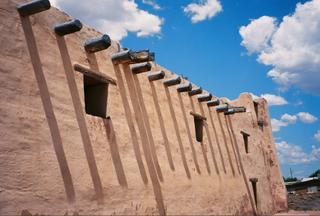
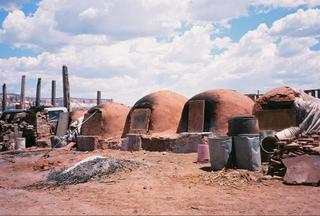
As we strolled the village, windows would be thrown open with people beckoning, asking if we wanted to buy a kachina or a painting. Zuni is still very much a community of artisans with cottage industry making up the bulk of the residents' livelihoods. The Zuni visitor's guide states that 80% of the pueblo population is involved in artistic endeavors, and they are reknowned for their intricate jewelry designs and their hand-carved fetishes.
We visited a pueblo-owned cooperative which sells jewelry-making supplies to the artists as well as consigns finished products for purchase by visitors. During our stop we witnessed the exchange of several artists with the manager, asking for their wares to be consigned. Some met with success, others received a firm but kindly, "Ummm, I'm going to pass on that one today." The old ways still prevail. I purchased a gorgeous and unusual pair of earrings, as did my sister, hers displaying the famous Zuni inlay of stones. Both items were accompanied by cards of authenticity and the name of the artist. They are, rightfully, very proud of their high quality craftsmanship.

We retraced our route homeward, thoughts lost in the starkness of the picturesque landscape here. These striped mesas and turquoise skies are magnificent, timeless, inspiring. No wonder the Zuni are famed for their works of art; they have daily inspiration.
copyright 2005 Valerie Schneider
It has been many years since we've ventured further west than Acoma, so we packed a picnic and embarked on the drive to Zuni Pueblo. From Acoma onward the vistas stretch out into infinite skies. Passing El Malpais is always interesting, the miles of rough, black lava rock a forbidding and yet beautiful landscape. The conquistadores traversed this vast stretch of dangerous territory in search of the Cibola, the fabled seven cities of gold. It is jagged and sharp, with lava tubes, caves, and sink holes, making it very treacherous terrain. To the north Mount Taylor looms large over the landscape. Mount Taylor's 11,300 foot peak is considered sacred by the Navajo who call it Turquoise Mountain.
Turning south put us into mesa country, with the rock formations rising up along the horizon. The road unrolled itself through the mesas as we approach El Morro National Monument. The sky was completely turquoise and punctuated with bright white, puffy clouds. There is an almost-spiritual feeling in the landscape here. Ancient. Creation. Beautiful.

El Morro National Monument is identifiable from the distance, a huge sandstone rock juts up above the desert floor, beckoning. It beckoned travelers of old with its refreshing natural pool in the shadow of the bluff, and they left their marks on the sandstone, carving their names into the rock. Most begin "Paso por aqui..." I passed this way. Some are elaborate with swirling script. They are a chronicle of the various groups who entered the New Mexico territory...the conquistador and colonizer Don Juan de Onate with the oldest inscription from 1605, Army regiments, passing settlers, they all incised their names on the walls, alongside timeless Anasazi petroglyphs.

Further along the road the striped mesas appear, the striations in the rock colorful against the deep turquoise sky. Graceful rock spires, separate from the larger formations, jut heavenward almost like church steeples and, with the stripes in the rocks reminiscent of several Italian cathedrals we have seen, the impression of a spiritual quality of this landscape deepened. All was silence until a passing truck rumbled by.
The visitors centers for both El Morro and El Malpais were very uncrowded. It is off the beaten path and yet there are miles of trails, a section of the famed Continental Divide Trail passing by here. But it was very hot, in the mid 90s and with nearly full sun exposure, it is still a forbidding landscape, which makes it an unspoiled landscape as well. No developments, no roadside kitsch, nothing to mar the expansive vistas.
We motored into Zuni Pueblo, one of the oldest, the largest, and most traditional of New Mexico's nineteen pueblos, yet unlike many of their tribal neighbors, they are an open pueblo and allow visitors to wander freely. After stopping at the tribal offices to purchase a photo permit, we explored Halona Idiwan'a, the Middle Village, one of the historic residential communities where the Old Zuni Mission and the ceremonial plaza are located. The traditions passed down from time immemorial are still carried on in Zuni. We walked the dusty paths that wind among the stone dwellings; we passed rows of hornos where the oven bread is baked. The Old Mission Church is in serious need of repair, the money the State has allocated will not cover the necessary renovations, we were told.

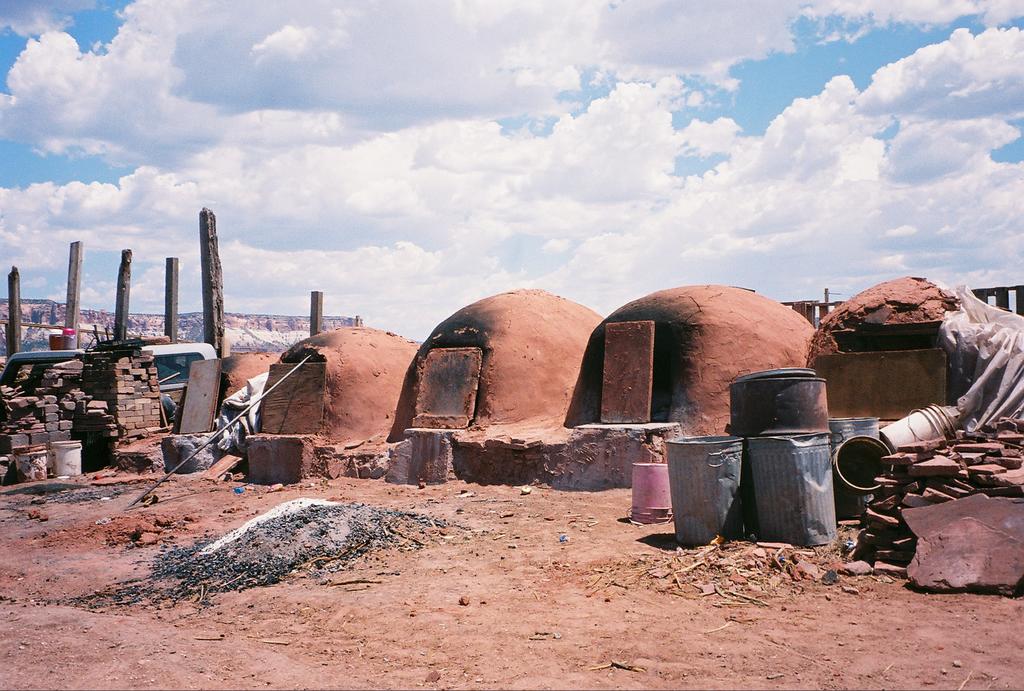
As we strolled the village, windows would be thrown open with people beckoning, asking if we wanted to buy a kachina or a painting. Zuni is still very much a community of artisans with cottage industry making up the bulk of the residents' livelihoods. The Zuni visitor's guide states that 80% of the pueblo population is involved in artistic endeavors, and they are reknowned for their intricate jewelry designs and their hand-carved fetishes.
We visited a pueblo-owned cooperative which sells jewelry-making supplies to the artists as well as consigns finished products for purchase by visitors. During our stop we witnessed the exchange of several artists with the manager, asking for their wares to be consigned. Some met with success, others received a firm but kindly, "Ummm, I'm going to pass on that one today." The old ways still prevail. I purchased a gorgeous and unusual pair of earrings, as did my sister, hers displaying the famous Zuni inlay of stones. Both items were accompanied by cards of authenticity and the name of the artist. They are, rightfully, very proud of their high quality craftsmanship.

We retraced our route homeward, thoughts lost in the starkness of the picturesque landscape here. These striped mesas and turquoise skies are magnificent, timeless, inspiring. No wonder the Zuni are famed for their works of art; they have daily inspiration.
copyright 2005 Valerie Schneider
Monday, July 11, 2005
The Chill of Summer
An inventiory of my closet recently reminded me of several summery dresses and skirts I possess but haven't worn in quite some time. I couldn't remember why they were languishing in my closet, and the temperatures being in the high 90s, I decided now was the time to extract them and put them to good use. I started with a little sleeveless denim, above-the-knee number. Cute, I thought. Why haven't I gotten this out sooner? Summer's been in season a while now. This is perfect.
Out I went into the arid fiery day. I met my sister for lunch, looking summery and cool. The sun beat down but I felt well-dressed for it. Entering the restaurant I was suddenly reminded of the reason the airy little dresses were hidden away. Like an arctic blast, the air conditioning pounded down on me, rendering me with goosebumps. It was 97 degrees outside, yet I stiffened and chilled like celery in ice water. Oh yes. The ol' freeze-ya-to-death-in-the-middle-of-summer routine we are forced to face every year.
Now, don't get me wrong...I'm grateful for air conditioning. I don't know that I could live in this high desert environment without it. Our swamp cooler is running constantly throughout the day during this season while we await the cooling monsoons. As I mentioned in a previous post, I am much more well-tolerant of heat than cold, and I'm usually good to about 93 degrees, then the heat overtakes me and I start to feel wilty and cranky. Air conditioning helps that condition. I just prefer logic be utilized and the air be conditioned, not iced.
A swamp cooler is a pretty basic contraption, actually. Water is pumped onto birch pads and a fan blows over it, forcing the cool air through the vents into the home. Almost ingenious, really, and normally pretty effective for a desert locale such as this. Swamp coolers, though, were a new mystery to us when we first moved to New Mexico. Coming from the humid, muggy midwest we couldn't fathom that moisture would be put into the air to cool a home. In our first, teensy efficiency apartment there was a switch to turn on the air and a thermostat, so ignorant little Ohioans that we were, we turned on the air to cool the stuffy flat and went to bed. Some time in the middle of the night we were shocked awake by the blaring, incessant and hellacious beeping of the smoke alarm. It turned out that swamp coolers don't turn off when the air reaches the desired temperature, they're a manual device. The air had gotten too cool, the thermostat registered and turned on the little wall-mounted heater, which in turn started to smolder an afghan which was thrown over the back of a chair next to said heater. We jumped up and threw the poor afghan -which was painstakingly handmade for me by an elderly aunt- into the shower to extinguish the smoke, pulled the batteries out of the smoke alarm and peeked outside to see if our poor, elderly neighbors were needing emergency attention due to the heart-stopping noise our alarm elicited. Our landlord came and gave us a crash-course in swamp cooler function the next day.
More educated now, we utilize our swamp cooler efficiently and regularly. So the fact of air conditioning is not an issue for me. It is the fact that too many business establishments set the air at glacial chill that bothers me. Why, when it is 97 degrees, must I tote around a sweater? Wear long pants? Forego the adorable little sleevless tops I possess, which are perfect for hot weather, I may add. Why? Why the extremes of temperature? It's a mystery. I may never figure it out. It seems not only illogical but ineffecient energy usage, too. I know I'm not the only one. I've seen other women yanking on jackets or sweaters to fend off the interior shivers. Then, when we depart, we are hit with the reverse blast-the sizzling outdoor air-and with one accord we quickly peel off the coverings, the hot air actually welcome relief.
It's silly. I call for common sense! I ask for a logical temperature to be utilized! I want to wear my sundresses and my sleeveless tops! I'll get the chance soon, when winter arrives and the same establishments have the heat cranked up.
Out I went into the arid fiery day. I met my sister for lunch, looking summery and cool. The sun beat down but I felt well-dressed for it. Entering the restaurant I was suddenly reminded of the reason the airy little dresses were hidden away. Like an arctic blast, the air conditioning pounded down on me, rendering me with goosebumps. It was 97 degrees outside, yet I stiffened and chilled like celery in ice water. Oh yes. The ol' freeze-ya-to-death-in-the-middle-of-summer routine we are forced to face every year.
Now, don't get me wrong...I'm grateful for air conditioning. I don't know that I could live in this high desert environment without it. Our swamp cooler is running constantly throughout the day during this season while we await the cooling monsoons. As I mentioned in a previous post, I am much more well-tolerant of heat than cold, and I'm usually good to about 93 degrees, then the heat overtakes me and I start to feel wilty and cranky. Air conditioning helps that condition. I just prefer logic be utilized and the air be conditioned, not iced.
A swamp cooler is a pretty basic contraption, actually. Water is pumped onto birch pads and a fan blows over it, forcing the cool air through the vents into the home. Almost ingenious, really, and normally pretty effective for a desert locale such as this. Swamp coolers, though, were a new mystery to us when we first moved to New Mexico. Coming from the humid, muggy midwest we couldn't fathom that moisture would be put into the air to cool a home. In our first, teensy efficiency apartment there was a switch to turn on the air and a thermostat, so ignorant little Ohioans that we were, we turned on the air to cool the stuffy flat and went to bed. Some time in the middle of the night we were shocked awake by the blaring, incessant and hellacious beeping of the smoke alarm. It turned out that swamp coolers don't turn off when the air reaches the desired temperature, they're a manual device. The air had gotten too cool, the thermostat registered and turned on the little wall-mounted heater, which in turn started to smolder an afghan which was thrown over the back of a chair next to said heater. We jumped up and threw the poor afghan -which was painstakingly handmade for me by an elderly aunt- into the shower to extinguish the smoke, pulled the batteries out of the smoke alarm and peeked outside to see if our poor, elderly neighbors were needing emergency attention due to the heart-stopping noise our alarm elicited. Our landlord came and gave us a crash-course in swamp cooler function the next day.
More educated now, we utilize our swamp cooler efficiently and regularly. So the fact of air conditioning is not an issue for me. It is the fact that too many business establishments set the air at glacial chill that bothers me. Why, when it is 97 degrees, must I tote around a sweater? Wear long pants? Forego the adorable little sleevless tops I possess, which are perfect for hot weather, I may add. Why? Why the extremes of temperature? It's a mystery. I may never figure it out. It seems not only illogical but ineffecient energy usage, too. I know I'm not the only one. I've seen other women yanking on jackets or sweaters to fend off the interior shivers. Then, when we depart, we are hit with the reverse blast-the sizzling outdoor air-and with one accord we quickly peel off the coverings, the hot air actually welcome relief.
It's silly. I call for common sense! I ask for a logical temperature to be utilized! I want to wear my sundresses and my sleeveless tops! I'll get the chance soon, when winter arrives and the same establishments have the heat cranked up.
Tuesday, July 05, 2005
Independence Day, Village Style
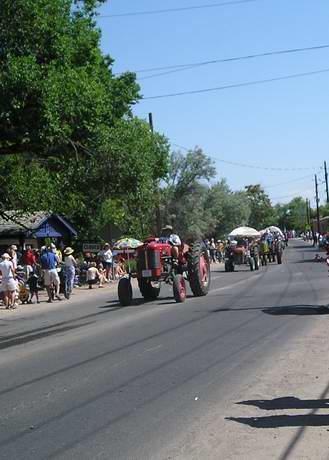
July 4th in Corrales...it's a hot experience. Temps always hit the mid-90s and people must scramble for shade as they line the main road waiting for the parade to start. We have watched the parade mushroom from an animals-and-kids-on-bike affair to a full-fledged parade. Animals do still play an important role, though.
Corrales was founded in 1706 and retains an air of its agricultural heritage, despite the burgeoning housing imposing itself onto the previously farmed fields. The village is trying hard to retain its rural roots and maintain small-scale farming. We have apple orchards and chile fields along the main road, and a few vineyards in the village, too. So it's no surprise that the main event of the July 4th parade is the tractor section. Lots and lots of tractors.
Horses are ever-popular, too. Because most residents have an acre or more of land, horses and other barnyard animals are ubiquitous. In our own neighborhood there are horses, llamas, and chickens, all of which were represented in our hour-long parade.


Kids scrambled in the street to pick up the handfuls of candy being dispensed more freely than water, though water was dispensed by some floats and entrants through super-soaker squirt guns. The Boy Scouts, ever entrepreneurial, walked the street with rolling coolers of bottled water that they sold for $1.
There was the local VFW group, who received applause and standing ovations along the entire parade route. There was a float by a nearby tattoo parlor displaying their various forms of human artistry; an original "chair brigade", a group of women marching with folding lawn chairs performing synchronated moves and marches (yeah, you had to see it); a kazoo band; and lots of Harley riders. Not many politicians this year; I guess they don't turn out when it's not an election year.
And of course what would a parade be without the pooper scoopers?
The streets were packed with smiling faces and happy kids. It's a little slice of life, village style...the simple pleasures of Independence Day.
Too hot to cook, we joined with millions of other fellow Americans in lighting up the grill. Potato salad, grilled chicken, baked beans (in the Crock-pot, did I mention it was really hot?) and white sangria...a much more "all-American" meal than I normally prepare. If only I hadn't forgotten the watermelon.
Fireworks exploded the sky to the south of us with spectacular color. The view from our courtyard afforded us a full show. Independence Day, village style.
copyright 2005 Valerie Schneider
Thursday, June 23, 2005
A Daily Life
I've been feeling a little melancholy this week. I've been thinking a lot about my grandpa and feeling his absence. I wish I could call and say hello...hear him say that he's "fit as a fiddle". I am wishing I could have seen him one last time. Maybe this melancholy is because of Father's Day, when I would have called him, when I pause to be thankful for the men who provided stability and assurance in my life. Maybe it's just the permanence of his absence settling on me that is making me feel a little misty. Or maybe it's my choice of reading material.
After my grandpa died, we moved Grams into a smaller apartment. When we were cleaning the old apartment my mom came across a stack of books, piled in a closet. "OH MY!," she exclaimed. "Mom's journals!" The pile of books with Year Book proclaimed in gold lettering on each dated mostly from the late 60s and 70s. This was a revelation to me; I had not known that for most of her adult life my grandma kept these diaries. All those years, seeing them so frequently, spending countless nights at their house...yet I had never seen these numerous leather-bound books before.
It has been interesting reading.
She wrote very dispassionately. These diaries are not a compilation of her thoughts, dreams or heart-aches. She wrote, instead, of her day. Every day. For years. The activities of the family members; what chores or activities she performed each day; where she walked; who she wrote letters to or received letters from; who visited. The picture that emerged of my grandma's life is drawn in bold lines, a black and white sketch, the color and depth of emotions are not brushed into the portrait.
She did write of her worries -occasionally- usually involving one of her children. Dean seems to be working too hard, making himself sick; Roger is having problems at school; Judy is having tremendous headaches. These statements seemed to be written out of helplessness to do much, and my grandma didn't like being helpless.
Her own activities were recorded. She baked bread three times a week for 50 years. Never learning to drive, she walked everywhere she needed to go - and often bummed rides home. "Walked to the library, got a ride home from Flossie." Everything she needed was in reach. She could walk uptown and have breakfast, buy a shirt, shop for a washing machine, stop at the grocery store on the way home. The small town had all she needed. Her journals portray a way of life that -in just a few short decades - has largely slipped away. Now we drive everywhere, Main Street no longer has a department store or appliance store and precious few places for dining and gathering, either. It seems that life was spent, rather than consumed. And she seemed content.
My grandpa worked two jobs with an occasional third job, too. He worked hard. But so did my grandma. She scrubbed, cooked, ironed piles of clothes - her own family's and others'- and washed using her old wringer washing machine, then hung the clothes outside to dry. She took us grandkids to give my mom a break. She baked cookies or pies or cakes, every day. She mended clothes. She played with us grandkids. She allowed herself an indulgence - after lunch she sat down and watched her "program". Every day. For years.
Her greatest joys were found in the simplest pleasures - a picnic, a phone call or card received in the mail, a card game with friends, a visit to family members on a farm, a snowball fight. She loved a country drive and a stop for ice cream on the way home.
The most striking thing that emerged as I read several years' worth of her daily activities was the fact that she did something for someone else every single day of her life. Baking bread, making meals, cleaning a house, writing letters. Cleaning the church linen, visiting invalid nuns, helping at the nursing home. Every day. For years. She took meals to one family daily for more than six months. She looked in on another elderly lady and visited with her, cleaned her house, weeded her flower beds. She cared for an elderly and senile aunt who became nasty and spiteful toward my grandma, yet Grams continued and wrote that "Aunt Elsie didn't know what she was doing." Grams recognized the needs of the person behind the facade. It upset her, yet she gave her all. She was involved in her community and in her church. She cared for the people around her. It was a part of her day. Every day. For years.
Her fulfillment came from helping others and caring for her family. Every day. She spent her energies, she invested herself. She cared. She had a servant's heart. She did all these things despite regular pain and fatigue. She often wrote that her "hip hurt something awful", yet she cooked and delivered meals. She frequently said she was "so tired", yet she scrubbed the floors and organzined meetings for the Altar Society.
These are the things my grandma recorded - daily life, as it was. I'm glad she did. I see her now, at nearly 95 being cared for, her investments yielding a return. Yet I wonder if she looks around and wishes she were helping rather than being helped. It was, after all, her way of life. Every day. For years.
copyright 205 Valerie Schneider
After my grandpa died, we moved Grams into a smaller apartment. When we were cleaning the old apartment my mom came across a stack of books, piled in a closet. "OH MY!," she exclaimed. "Mom's journals!" The pile of books with Year Book proclaimed in gold lettering on each dated mostly from the late 60s and 70s. This was a revelation to me; I had not known that for most of her adult life my grandma kept these diaries. All those years, seeing them so frequently, spending countless nights at their house...yet I had never seen these numerous leather-bound books before.
It has been interesting reading.
She wrote very dispassionately. These diaries are not a compilation of her thoughts, dreams or heart-aches. She wrote, instead, of her day. Every day. For years. The activities of the family members; what chores or activities she performed each day; where she walked; who she wrote letters to or received letters from; who visited. The picture that emerged of my grandma's life is drawn in bold lines, a black and white sketch, the color and depth of emotions are not brushed into the portrait.
She did write of her worries -occasionally- usually involving one of her children. Dean seems to be working too hard, making himself sick; Roger is having problems at school; Judy is having tremendous headaches. These statements seemed to be written out of helplessness to do much, and my grandma didn't like being helpless.
Her own activities were recorded. She baked bread three times a week for 50 years. Never learning to drive, she walked everywhere she needed to go - and often bummed rides home. "Walked to the library, got a ride home from Flossie." Everything she needed was in reach. She could walk uptown and have breakfast, buy a shirt, shop for a washing machine, stop at the grocery store on the way home. The small town had all she needed. Her journals portray a way of life that -in just a few short decades - has largely slipped away. Now we drive everywhere, Main Street no longer has a department store or appliance store and precious few places for dining and gathering, either. It seems that life was spent, rather than consumed. And she seemed content.
My grandpa worked two jobs with an occasional third job, too. He worked hard. But so did my grandma. She scrubbed, cooked, ironed piles of clothes - her own family's and others'- and washed using her old wringer washing machine, then hung the clothes outside to dry. She took us grandkids to give my mom a break. She baked cookies or pies or cakes, every day. She mended clothes. She played with us grandkids. She allowed herself an indulgence - after lunch she sat down and watched her "program". Every day. For years.
Her greatest joys were found in the simplest pleasures - a picnic, a phone call or card received in the mail, a card game with friends, a visit to family members on a farm, a snowball fight. She loved a country drive and a stop for ice cream on the way home.
The most striking thing that emerged as I read several years' worth of her daily activities was the fact that she did something for someone else every single day of her life. Baking bread, making meals, cleaning a house, writing letters. Cleaning the church linen, visiting invalid nuns, helping at the nursing home. Every day. For years. She took meals to one family daily for more than six months. She looked in on another elderly lady and visited with her, cleaned her house, weeded her flower beds. She cared for an elderly and senile aunt who became nasty and spiteful toward my grandma, yet Grams continued and wrote that "Aunt Elsie didn't know what she was doing." Grams recognized the needs of the person behind the facade. It upset her, yet she gave her all. She was involved in her community and in her church. She cared for the people around her. It was a part of her day. Every day. For years.
Her fulfillment came from helping others and caring for her family. Every day. She spent her energies, she invested herself. She cared. She had a servant's heart. She did all these things despite regular pain and fatigue. She often wrote that her "hip hurt something awful", yet she cooked and delivered meals. She frequently said she was "so tired", yet she scrubbed the floors and organzined meetings for the Altar Society.
These are the things my grandma recorded - daily life, as it was. I'm glad she did. I see her now, at nearly 95 being cared for, her investments yielding a return. Yet I wonder if she looks around and wishes she were helping rather than being helped. It was, after all, her way of life. Every day. For years.
copyright 205 Valerie Schneider
Thursday, June 16, 2005
Critter Update
Because several people have inquired after the wildlife, I want to reassure you that - to our surprise - they have continued to visit. The baby quail are growing very quickly and seem unimpressed and nonplussed by the racket and earth-shaking going on next door. Yesterday morning they came despite the huge front-end loader. The mama seemed a bit nervous and kept a vigilant eye, but the chicks hopped happily about eating ants. We were able to witness their flight lessons. Mama flew up onto the wooden frame surrounding the compost and bid her birdies to follow. She half-flew/half-jumped and the chicks followed, some more reluctantly than others.
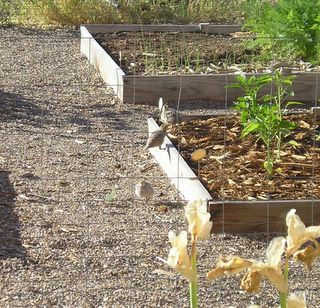
Quail chicks in the garden. Yes, I know they're hard to see with the gray stone.
The bunnies, too, are still habitually hopping by to see us (or rather, for us to see them). We actually seem to have more bunnies than before and we think that their habitat was destroyed when the sage was torn out next door. Suddenly instead of just three, we've been seeing five, and there seems to be a bit of a territorial issue going on. One will be at the water dish or munching carrot trimmings when another will hop down the path. The first one jumps, slicks back his ears, and chases the intruder off. Then another one comes and scares of the first bunny. We have been amused and entertained by them.
So yes, the critters continue to be as amusing as ever. And the construction next door continues to be as loud and obnoxious as ever. But that's another story.

Rabbit reposing on the pathway, with another bunny in the background.

Chicks and mama quail, with a bunny at the water dish (darn that gray stone!)

Quail chicks in the garden. Yes, I know they're hard to see with the gray stone.
The bunnies, too, are still habitually hopping by to see us (or rather, for us to see them). We actually seem to have more bunnies than before and we think that their habitat was destroyed when the sage was torn out next door. Suddenly instead of just three, we've been seeing five, and there seems to be a bit of a territorial issue going on. One will be at the water dish or munching carrot trimmings when another will hop down the path. The first one jumps, slicks back his ears, and chases the intruder off. Then another one comes and scares of the first bunny. We have been amused and entertained by them.
So yes, the critters continue to be as amusing as ever. And the construction next door continues to be as loud and obnoxious as ever. But that's another story.

Rabbit reposing on the pathway, with another bunny in the background.

Chicks and mama quail, with a bunny at the water dish (darn that gray stone!)
Thursday, June 09, 2005
Backyard Wildlife
A scene has been playing out daily this past week as I awake and go into the kitchen for my morning coffee. I peek out the window and see a bevy of infant quail in my garden, their mama hovering over them. The little aviary fluff-balls squeak and hop around merrily, digging their little beaks into the sand to find their buggy breakfast. There are thirteen of them. The sole adult female stands guard on the gate, then hops down into the garden for a bite or two herself. When the babies have satisfied their hunger, they scurry out the rabbit fence into the sagebrush. The mama bird, however, is quick to forget that she has wings and, in a panic, runs along the fence, pecking at the grating, throwing herself against it, trying to exit in the manner her little flock did. Eventually she remembers her flight capabilities and makes a hop over the barrier to her waiting chicks.
In addition to the adorable avians, we have a few cute cottontail rabbits who routinely visit, looking for scraps from the garden and to drink from the water dish we've put out to attract such creatures. One of these, also, is a baby bunny and hops around in circles between the water dish and the carrot scraps, as if undecided which he wants first. Once the carrots win over, he nibbles nimbly away at the stalk and orange flesh, lifting his head to look around from time to time, skiddish to any sound that will cause him to high-tail it into the brush.
We also have a fair share of roadrunners -our state bird- coming to torment Winston, the birds seemingly knowing that he is too old and unable to jump very high to pursue them, they perch on the courtyard wall and cause him to emit his "kitty chatter" and slump down in a pounce position, which never changes into an actual pounce. The roadrunner are as large as him, in any case, and he probably wouldn't have pounced even in his younger days.
These backyard wildlife viewings have suddenly, we fear, been eliminated due to a new, more beastly invasion: construction on the lot next door. We've known that a house would be built there, and we've been fortunate that in our nine years of residence in Corrales we've not had this ordeal sooner. It began with a large well-drilling truck churning up a racket on Tuesday. Wednesday brought a huge front-end loader which was noisily used to begin digging a gigantic hole, the purpose of which we can't imagine. Basements are practically non-existant in New Mexico, as are crawl spaces. No other builders in our area (that we've seen, and lots of homes have gone up since we've moved here) dig out large expanses such as this. Last night the noise blessedly stopped at about 5:20 p.m. so we started dinner and set the table outside. The moment - honestly, the very instant- I brought out the food, a worker returned to the big water truck, started up the rumbling diesel engine and proceeded to wet down the big pile of dirt. This morning, instead of the usual chirps and calls of the birds to awaken us, the whining drone of the front-end loader began at 6:40 a.m. Thank you so much.
This wouldn't be so bad (though I do dislike mechanical wake-up calls before 7:30 a.m.) were it not for the manner in which it all started. The builder staked out the lot about two weeks ago, and we winced. The stakes, indicating the position of the gigantic home to be built, also indicated that our view would be decimated. We were, naturally, disheartened and displeased. Knowing that the subdivision has covenants in place and that plans have to be submitted to an architectural committee for review, though, we waited, hoping. One of the three committee members came out to the lot with the plans and surveyed. He walked all over, from stake to stake, while consulting the builder's plans. He recommended moving the structure 20 feet south, which he said would not impact their views at all because of window orientation, but would help our views quite a bit. The builder informed him that the buyers refused. They wanted the view they wanted, and that was it. They hadn't even considered that a home was already in place behind them. Or they just didn't care. Back and forth we went with the poor committee member - a neighbor - in the middle. It looked as if the only way to preserve any semblance of a view would be to obtain an injunction and then sue. Not something we wanted to do for many reasons, including cost. Eventually the builder convinced the buyer to move the structure 10 feet south. Oh, thank you generous buyers, I say tongue-firmly-in-cheek. We're not unrealistic, we knew our view wouldn't be what it has been for nine years and that it would be partially obstructed. But the audacity to plop their monstrosity directly in front of every single one of our windows irked me tremendously. We are so looking forward to living next to these affable, neighborly people.
Our friends and family have been offering helpful advice:
"Get yourself a nice, noisy rooster."
"Put in a pig pen right on the lot line and upwind. I think Bryan would make a good pig farmer!"
"Ask the neighbors on the other side of them to erect a very high fence."
"Invite your electric guitar-playing brother for a loud visit."
All tempting suggestions.
We are anticipating five to six months of construction noise. In the meantime, we wonder what will become of our fluff-ball quail babies and bunny visitors. We rather enjoyed our backyard wildlife. I hope they're smart enough to scurry around to the front yard, where there are no gaping holes or noisy mechanical things devouring their habitat. If not, it may be rather lonely out here on the mesa. They sure have been better, friendlier neighbors than the ones moving in.
copyright 2005 Valerie Schneider
In addition to the adorable avians, we have a few cute cottontail rabbits who routinely visit, looking for scraps from the garden and to drink from the water dish we've put out to attract such creatures. One of these, also, is a baby bunny and hops around in circles between the water dish and the carrot scraps, as if undecided which he wants first. Once the carrots win over, he nibbles nimbly away at the stalk and orange flesh, lifting his head to look around from time to time, skiddish to any sound that will cause him to high-tail it into the brush.
We also have a fair share of roadrunners -our state bird- coming to torment Winston, the birds seemingly knowing that he is too old and unable to jump very high to pursue them, they perch on the courtyard wall and cause him to emit his "kitty chatter" and slump down in a pounce position, which never changes into an actual pounce. The roadrunner are as large as him, in any case, and he probably wouldn't have pounced even in his younger days.
These backyard wildlife viewings have suddenly, we fear, been eliminated due to a new, more beastly invasion: construction on the lot next door. We've known that a house would be built there, and we've been fortunate that in our nine years of residence in Corrales we've not had this ordeal sooner. It began with a large well-drilling truck churning up a racket on Tuesday. Wednesday brought a huge front-end loader which was noisily used to begin digging a gigantic hole, the purpose of which we can't imagine. Basements are practically non-existant in New Mexico, as are crawl spaces. No other builders in our area (that we've seen, and lots of homes have gone up since we've moved here) dig out large expanses such as this. Last night the noise blessedly stopped at about 5:20 p.m. so we started dinner and set the table outside. The moment - honestly, the very instant- I brought out the food, a worker returned to the big water truck, started up the rumbling diesel engine and proceeded to wet down the big pile of dirt. This morning, instead of the usual chirps and calls of the birds to awaken us, the whining drone of the front-end loader began at 6:40 a.m. Thank you so much.
This wouldn't be so bad (though I do dislike mechanical wake-up calls before 7:30 a.m.) were it not for the manner in which it all started. The builder staked out the lot about two weeks ago, and we winced. The stakes, indicating the position of the gigantic home to be built, also indicated that our view would be decimated. We were, naturally, disheartened and displeased. Knowing that the subdivision has covenants in place and that plans have to be submitted to an architectural committee for review, though, we waited, hoping. One of the three committee members came out to the lot with the plans and surveyed. He walked all over, from stake to stake, while consulting the builder's plans. He recommended moving the structure 20 feet south, which he said would not impact their views at all because of window orientation, but would help our views quite a bit. The builder informed him that the buyers refused. They wanted the view they wanted, and that was it. They hadn't even considered that a home was already in place behind them. Or they just didn't care. Back and forth we went with the poor committee member - a neighbor - in the middle. It looked as if the only way to preserve any semblance of a view would be to obtain an injunction and then sue. Not something we wanted to do for many reasons, including cost. Eventually the builder convinced the buyer to move the structure 10 feet south. Oh, thank you generous buyers, I say tongue-firmly-in-cheek. We're not unrealistic, we knew our view wouldn't be what it has been for nine years and that it would be partially obstructed. But the audacity to plop their monstrosity directly in front of every single one of our windows irked me tremendously. We are so looking forward to living next to these affable, neighborly people.
Our friends and family have been offering helpful advice:
"Get yourself a nice, noisy rooster."
"Put in a pig pen right on the lot line and upwind. I think Bryan would make a good pig farmer!"
"Ask the neighbors on the other side of them to erect a very high fence."
"Invite your electric guitar-playing brother for a loud visit."
All tempting suggestions.
We are anticipating five to six months of construction noise. In the meantime, we wonder what will become of our fluff-ball quail babies and bunny visitors. We rather enjoyed our backyard wildlife. I hope they're smart enough to scurry around to the front yard, where there are no gaping holes or noisy mechanical things devouring their habitat. If not, it may be rather lonely out here on the mesa. They sure have been better, friendlier neighbors than the ones moving in.
copyright 2005 Valerie Schneider
Subscribe to:
Posts (Atom)


 Posts
Posts


